All posts by Travis Allen

Travis Allen has been playing Magic on and off since 1994, and got sucked into the financial side of the game after he started playing competitively during Zendikar. You can find his daily Magic chat on Twitter at @wizardbumpin. He currently resides in upstate NY, where he is a graduate student in applied ontology.

Grab Bag #1

ADVERTISEMENT:


Nothing has really struck me this week as a topic I want to devote an entire article to, but I’ve got a few small ideas floating around and some short-form questions on Twitter to answer. So today is the first in what will likely be an infrequently recurring series that are a collection of mostly-disparate topics.


True-Name Nemesis

As was expected, TNN put up solid results at Grand Prix DC this weekend. He was all over the winning grinder lists and X-0 day one records, with 9 copies in the Top 8 and 3 in Owen’s winning list. Not surprisingly, his price has now reached a comfortable $40. Remember last week when he was ~$33 and I told you not to sell until after DC? Hey, well look at that! True-Name Nemesis

He’s absolutely the real deal, so don’t expect him to fade away anytime soon. Demand from Legacy players will persist, and he’s a three-of or four-of type of card, which helps significantly. I doubt he gets below $30 anytime before a second printing, and I would guess $35 is a soft floor. Copies are still flowing from people that snatched up cheap decks at Target which will keep him from inflating too much in the coming weeks, but after a few months there will be a far less liquid supply. At that point, his price will begin to rise more reliably once everyone that wanted to sell theirs has. If you want to profit, feel free to sell, as his price may slip a bit in the short term. Don’t feel bad about holding on though, especially if you may actually play with him, as I don’t believe we’ve reached his ceiling yet. A limited-run card that’s a four-of in Legacy with tremendous casual appeal (protection from players is a really nifty ability) is a conflux of valuable factors.


Magic the Gathering Offline

The MTGO partial shutdown will have far reaching ramifications that will take months to unfold and see the full implications of. I will try my best to make a guess at what the immediate impact will be though.
Capture

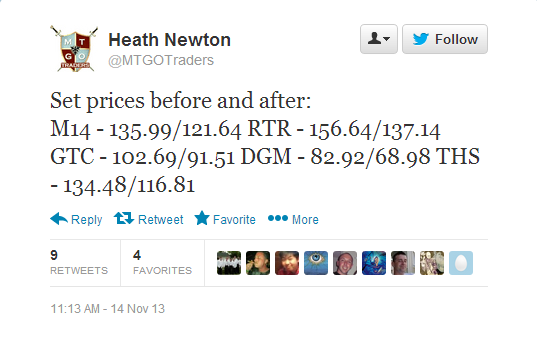
That tweet is showing the prices to complete a full set (1x) on MTGO before and after the announcement. At this point, there has been a 10-20% drop in prices on Theros and RTR block cards. Players apparently don’t expect premier constructed events to be returning in a week or two, which is why prices are taking such a hit. If the expectation was that events will only be gone for a few weeks, then prices wouldn’t have seen much of an impact. But with the announcement about how long of a downtime to expect not being promised until sometime before the end of the year, it’s safe to assume that this is a several month – or, Worth forbid, a several year – project.

With a significant drop in value of cards online, as well as the upcoming Standard PTQ season in meatspace, we may see an above-average amount of redemptions occurring. This means a greater number of Standard cards becoming available in paper, suppressing card values in the real world by some amount. I would especially expect a greater supply of RTR block cards relative to Theros, as Theros will remain relevant beyond the summer, while RTR mostly will not. It’s also worth noting that apparently cards for Modern, Legacy, etc have not dropped much/at all in value, meaning players don’t expect this to be the death of MTGO, but rather a medium-term disruption in service. They may not know what Standard format we’ll be in when dailies return, but they know Modern ones won’t have changed much.

As per how much redemption will occur, we really don’t know, and Wizards won’t be in a rush to tell us either. I don’t expect it to have a severe effect. A (very, very) rough guesstimate is that the extra redemptions may account for a percentage point or two of additional product in the real world, but I wouldn’t fault a knowledgeable party for expecting the impact to be ten times that. It’s just very difficult to get a bead on it.

An interesting side effect of all of this is that RTR block cards may hold their value quite well on MTGO going long. If a large percentage of RTR cards get taken out of MTGO during this period, in two years there will be a lot less digital Supreme Verdicts, Abrupt Decays, and Deathrite Shamans running around.


What Happened with FTV:Twenty?

When FTV:20 was announced, preorders were in the ~$150-250 range. That was typical for a new FTV. Hype was high, as this FTV had five extra cards compared to previous years, as well as an air of excitement surrounding it, as players were eager to see what the 20th anniversary of Magic would bring. We hadn’t seen much marking this year as a celebration, so players were hoping FTV:20 would be something special.

I don’t recall at which event Jace was spoiled, but I seem to remember he was among the first three cards. Imagine the excitement at the time – three cards into twenty, and Jace is in there?! Preorders skyrocketed to $450. Who cares what else is in the other 17 cards? They can’t all be bad, and Jace! Don’t you understand? JACE! JAAAAACE! JAAAAAASGghghhhhhhh Fyndhorn Elves

Then the other 17 cards trickled in, and whoops, turns out they’re all boring. Which other cards were people supposed to get excited about? Kessig Wolf Run, a $2 land that was just in Standard? Or perhaps Char, which approximately zero people have cast in 2013? The third printing of Cruel Ultimatum not doing it for you? Well, check out Dark Ritual! Sure, it’s had roughly 80 printings, was foil twice, and this is terrible art, but DARK RITUAL! Guys? Where are you all going?

FTV:20 preorders hit $450 on a swirling mixture of hype, expectations, and the thrill of the unknown. Once the veil was parted, all of that dissipated and we were left with Jace and 19 other cards that were mostly entirely unexciting. By the time FTV:20 finally hit shelves, it was maybe $150. Today, sealed copies can be had for ~$125 on eBay, and Jace:20 is about $90, $10 less than WWK Jace.

What’s going to happen with Jace in the long term? Well, probably not a lot. His peak came and went this past summer. The amount of play he is seeing hasn’t increased at all, he’s absolutely not getting unbanned in Modern, and a slew of new copies were added to the market for anyone that really wanted them. Pack foils will stay absurd as a collector’s item, but that’s about it.

ADVERTISEMENT:


What Standard playsets should I pick up now?

I can’t tell you every Standard card you should own today, but I can give you a few pointers.
ADVERTISEMENT:


master

Master of Waves

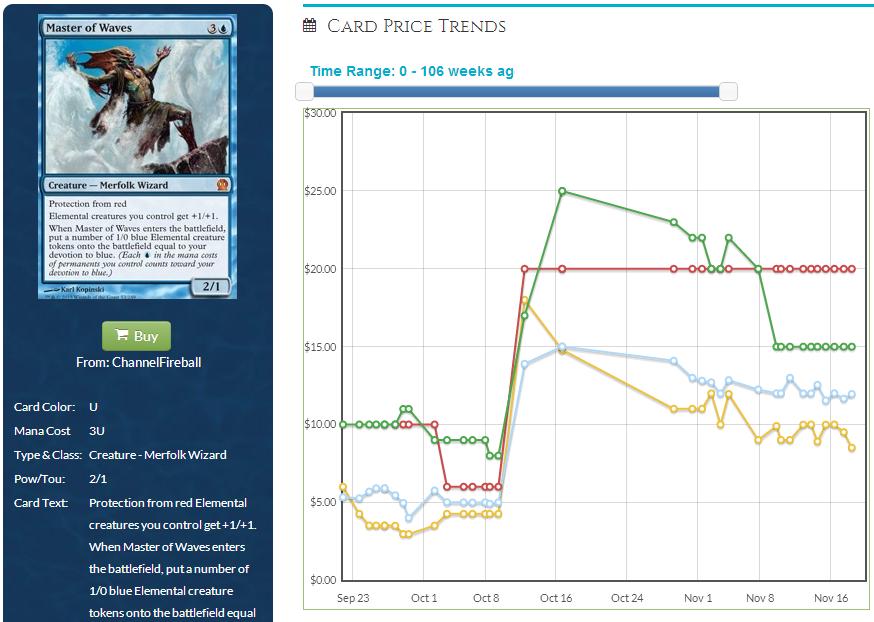
Our new Merfolk overlord has proven he’s here to stay. Variants of blue devotion continue to put up strong results week after week in Standard, he’s revitalized merfolk in Modern, and I’ve even seen him pop up in Legacy. Despite all of this, he’s snuck down to ~$12, and I spy a few retail copies for under $10. I would not hesitate to trade for this guy, and don’t be afraid to pick up more than just a playset. His floor can’t be much lower than $7 or $8, and his ceiling is in the ballpark of $20-$25.


Chandra, Pyromaster

Chandra, Pyromaster

Immediately after release Chandra burned all the heretics at the stake, but since then has been relatively quiet. Devotion decks and various forms of control have taken the spotlight, leaving Chandra without much to do. She’s now around $20-25, nearly half of what she once was.

I’m optimistic about Chandra’s future. Keep in mind that she’s got two red symbols in her mana cost, which is good for Nykthos fans. That middle ability also plays well with Nykthos, as generating big mana is a lot easier than it used to be. We certainly haven’t seen the last of her.

Pick up a playset, but don’t go much deeper than that. While $20 is close to her floor, breaking $30 again will be very tough. She’s also as close to a guaranteed reprint in M15 as a card could be at this stage (along with Garruk), so you don’t want to end up too deep when the inevitable price drop comes. Pick up your four ahead of PTQ season, but remember that any you keep past March will become a liability.


Nykthos, Shrine to Nyx

Nykthos, Shrine to Nyx

Have you figured out this land is legit as hell yet? Because it is. It is legit as hell. Wizards has been telling us for years that they want us to play on the board, not on the stack, and Nykthos pays you hard for doing such. There are plenty of adorable combos floating around out there that haven’t broken into the mainstream yet either, meaning there is a lot of untapped (heh) potential in the card. Just this week MTGO personality Bing Luke (@prolepsis9) linked an event with Nykthos in Modern doing dirty business with Genesis Wave, which I can absolutely get behind. MTGPrice is showing the card around $10, and there are a few purchasable copies out there for under $9. Any that you can pick up in trade under $10 should be golden. Nykthos feels like a $15-$20 card to me.

Track your collection's value over time, see which cards moved the most, track wishlists, tradelists and more. Sign up at MTGPrice.com - it's free!


ADVERTISEMENT:


Alright, Just Hold Your Elephants

By: Travis Allen

The PTQ season change next year is going to have a direct impact on the pacing of Magic finances. I’ve discussed this change briefly before, but now we are very close to actually experiencing the new market.

Previously the Standard PTQ season occurred over the summer, around the release of the spring set. This helped keep Standard staple prices from crashing too low in the spring during the lead up to the PTQ season, and also meant that soon-to-rotate staples such as Thragtusk kept their value far, far longer than they normally would without the demand from grinders. Thragtusk

The new world awaits us on December 7th. On that day the Standard PTQ season begins, and will end on March 9th, 2014. And then…that’s it. By March (or really, mid February,) the demand for many Standard staples will completely bottom out, as only GPs and FNMs will exist to drive players to own and acquire Standard cards.

With the prior structure, the promise of the impending PTQ season during the summer meant that players didn’t have to feel bad about holding onto senior Standard cards through the first third of the year. Even if you weren’t using a card at that moment, you knew it would be relevant again before finally rotating out. In the new schedule, though, this promise of future utility will be gone. Once March 9th rolls around, it will be a free-fall for Ravnica block cards that don’t see heavy Modern or Legacy play. However, there is another byproduct of this change – demand will spike much sooner.

ADVERTISEMENT:


By the end of this month players will be gearing up for PTQs, a solid six months ahead of prior years. Because the season starts so close to Christmas I wouldn’t be surprised to see the demand stagger a bit until after the first of the year, but once we pass the holiday season, the dreary early winter months will hold nothing but PTQs for the ice mage. Demand will be at its peak in early to mid January, as Santa has come and gone, the end of the PTQ season is not quite on the horizon, and winter-set fervor hasn’t yet gripped the community.

What does this mean for the savvy trader? It means don’t trade those Advent of the Wurms, Aetherlings, Blind Obediences, or Angel of Serenitys quite yet.  It means now is when you should be acquiring Standard staples as aggressively as possible, and once we hit January, severely reduce your acquisition. (At that point, start grabbing safe Modern powerhouses ahead of that particular PTQ season.) It also means that we have a very clear window of opportunity for cashing out of any stockpiles you may have. This is the time to finally sell all your Ravnica specs that haven’t quite panned out for the best value those cards will likely see for years. Exava, Rakdos Blood Witch

Here’s your rule of thumb: If a card from Ravnica block spikes after December 9th, get rid of it and don’t look back. Lotleth Troll hit $4? Ship it. Exava reaches $5? Trade them. Advent of the Wurm climbs to $6? To eBay! If you trade Advent at $6 and then it hits $8 two weeks later, you have no reason to feel bad. The alternate universe where you hold out for another $1 and Advent instead crashes to two bucks is never more than a butterfly away.

I personally have a pile of foil Loxodon Smiters I grabbed during SCG’s back to school sale, when the price was lower than any other I could find on the internet. They haven’t doubled from what I paid like I hoped they would, but the PTQ season will give me my last chance to see a profit, or at worst, recoup some losses. If they haven’t jumped by the middle of January, I’ll be selling no matter what the price. If I have to lose $1 on each copy, that sucks, but it would be far better than stubbornly holding onto them only to realize I’m out $5 each in July. I’ve also got a fair bit of Detention Spheres whose intended sale was delayed by the event deck, several playsets of Supreme Verdicts, and some other odds and ends.

What you shouldn’t sell is cards already at their floor though. Don’t trade away Deadbridge Chants at $1 just because they aren’t lighting up the tournament scene. The card can’t get any lower, and while the general amount of value in Standard cards will be less post-PTQ season, it won’t be completely devoid of the occasional breakout deck jumping a random card by several dollars. Keep in mind too that towards the end of the PTQ season, Born of the Gods will be released, and bring with it new Scrylands, new enablers, and new decks.  

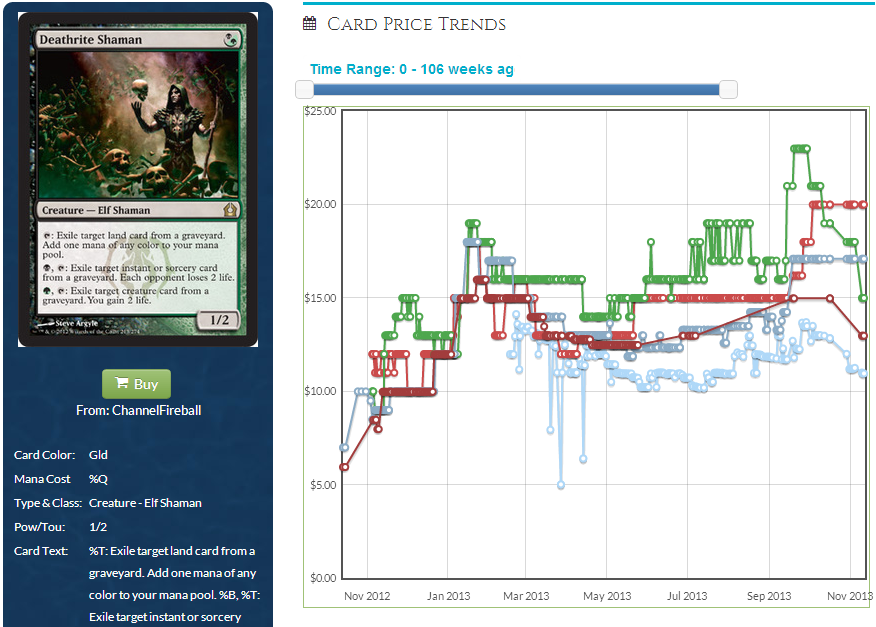
You also don’t need to be in a rush to divest from multi-format staples. What I wouldn’t be in a rush to ship are cards like Abrupt Decay, Deathrite Shaman, and so forth. These are cards whose value is mostly determined by Modern and Legacy, and while the rotation of Standard will count against them, it won’t be long before the interval since their printing will outweigh the loss of that format’s demand.

deathrite

The takeaway from all this is that you absolutely need to be aware of PTQ seasons in order to get the most out of your cards, and to make sure you don’t get caught holding the bag. Outing cards from the senior set in the middle of the relevant season is often your best chance to hit cards at what will be their highest peak for years. Take the profits where you can, swallow your pride if you need to sell for a loss, and stay a constructed format ahead of the grinders.

Weekly Roundup:

-I’ve mostly kept quiet about Commander 2013 and True-Name Nemesis relative to other financial talking heads, and that is because I haven’t felt like I’ve had anything useful to contribute to the conversation. I’m pretty comfortable at this point claiming TNN as a soft hold though. The release date of C13 was November 1st, and in the twelve days since then, he has shown up in the Top 8 of every Legacy and Vintage event I’m aware of. Most knew TNN was legit, but not many expected him to be this good.

The TNN quagmire is that we still don’t have a lot of reliable data about the printing of the Commander decks. We know Wizards has no intention of turning this into a Commander’s Arsenal, but honestly, I feel like they undershoot demand every single time on non-expansion sealed product. There’s also been a lot of swirling rumors about their printing intentions. One day you hear that they’re going to print these things until you could use them for shelter, then the next you hear that there’s only one more shipment and some guy named Bob who you don’t even think plays at your store already preordered and paid for them all.

Mark Rosewater said that Wizards doesn’t plan to continue printing individual decks, which is particularly important. It means that even if Target has no copies of the Grixis deck in stock (Mind Seize), the piles of Marath and Oloro they have will prevent them from ordering more. This all adds together for a reasonable conclusion that while supply overall isn’t constrained, any particular deck could become tough to find.

That obviously bodes well for TNN. He slipped to about $26 on eBay a week or so ago, but he’s since started climbing again, and honestly, I don’t see a reason for him to drop yet. Legacy players across the world are realizing this guy is legitimate, and the supply is not going to get significantly larger anytime soon. With Grand Prix DC this coming weekend being Legacy, it’s a high-profile event that could see True-Name Nemesis break out even harder. It’s hard to say what this guy’s possible ceiling is, but if the Grixis deck is shaping up to be as tough to find as it seems, and TNN being even better than we thought, $40 almost seems like a low ballpark. $50? $70? Who knows. He’s unprintable in Standard, so when they decide to add more copies to the market, it won’t be in a large volume. A judge promo is the most likely path Wizards would take. When he finally does start to fall, there won’t be enough copies entering the market to precipitate a rapid loss of value. Descent will be slow. For now, feel free to hold onto copies and ride out the wave.

-Brian Kibler’s article this week featured his latest Standard brew which contained 4x Reaper of the Wilds and Lotleth Troll. I’m not on board with buying into Trolls, but you’ll recall that I spoke highly of Reaper in my Theros set review. You can definitely find these as throw-ins right now, although I’ve noticed people were a bit more reluctant to trade these this past weekend than they were around release. I can’t recommend dumping cash into…him? but I would be more than comfortable picking up any that I could in trade.

Nykthos, Shrine to Nyx is hovering around $10. I am a firm buyer at that price. Ok maybe not buy with cash, but definitely trade for. Nykthos has proven itself week after week since the Pro Tour, and it’s the type of card you build a deck around. It couldn’t really get much lower than $7-8, and the ceiling is definitely over $20, especially with any Modern performance. Cards that get silly with Nykthos: Ral Zarek, Master Biomancer + Master of Waves.

The Twitter Primer (Fall ’13)

By: Travis Allen

Magic finance moves very fast these days. During Pro Tour Theros, Master of Waves quadrupled in price over the span of something like 14 hours. Nightveil Specter and Thassa saw similar rapid movement the same weekend. If had been watching Twitter that Friday afternoon you would have heard about the impending spikes and had the opportunity to make purchases based on that info. Of course you may have gotten your order cancelled, but at least you could have made great trades that night at FNM or on a Saturday afternoon draft. If, however, you didn’t learn about any of this until Monday or Tuesday morning when you read recaps of the weekend, you were already too late.

If you’re reading about a card’s rise in an article, the train has probably already left the station. At the time I’m writing this, it is Monday afternoon. Even if a card started moving as I’m typing – if Kibler tweets a picture of a deck with 4x Zegana claiming he broke it – and I put the breakout news in this piece, you wouldn’t read about it until Wednesday morning at the earliest. Meanwhile, Zegana would be sold out across the internet by Monday evening. This is why many discussions of individual cards in articles fall into one of two categories. Either the card already jumped and it’s a discussion of whether to hold or sell, or it’s a longer-term prediction that is truly predictive, and thus suffers a far less success rate unless the writer is nostradomesque.

What does all of this mean? It means that if you want to know what’s going on in the finance world, there is exactly one place to get the most up-to-date news: Twitter. There is no other single tool or medium that provides the real-time updates on hot tips alongside quality discussion from knowledgeable parties. I can’t tell you how many times I’ve read about a price spike on Twitter Friday afternoon, then scored several copies of the card for way under its new value several hours later at FNM. Knowledge = capital.

So you head off to twitter.com and register for a new account. Now what though? You can tweet into the aether, but that won’t get you very far without any followers. What you need is a lead on who to listen to. There are some obvious choices for the average MTG enthusiast, such as Aaron Forsythe (@mtgaaron), Mark Rosewater (@maro254), or Luis-Scott Vargas (@lsv). You will find plenty of other interesting accounts to follow by watching who these guys interact with, but my goal is to help you jump right into the thick of things.

Keep in mind that because of the way Twitter works, you only see a discussion between two parties if you follow both of them. If Aaron and Mark are tweeting back and forth, and you only follow one of them, you won’t see the conversation. This means that the amount of information available to you expands exponentially the more people you follow. A good deal of helpful insight comes in the form of conversations between several people, so make sure you err on the side of following more people than not.

What follows in no particular order is a list of individuals that can frequently be found discussing up-to-date finance info. This list is by no means exhaustive, but it will certainly get you started. I guarantee that if you follow these people and pay attention, they will make you money.


sigfig

@sigfig8

Sigmund is one of the first Magic finance guys I started following, and I still get good info from him regularly. He is most characterized by his love of sealed product and a predilection for prudent, lower-risk investments. A cautious voice in a realm prone to exaggeration and hype can help temper some of your more rash decisions.

In addition to his activity regarding Magic, Sigmund can often be found tweeting about real life stock investing, which can occasionally help provide a splash of reality when you stop and compare that to trading cardboard back and forth.


jason

@JasonEAlt

Jason Alt is one of the better known faces of Magic finance, and his work even occasionally appears here on mtgprice.com. Brainstorm Brewery, the (largest?) financial podcast, is also a home to Jason’s insight, where he is one of the distinguished hosts.

Being a large part of the community, a lot of useful information flows through and from him colored by his typical light derision. Jason is a great resource for hot card tips, as he passes along many things he hears that appear credible. You’ll also encounter plenty of other finance-minded types through his tweets.

becvar

@Becvar

Nick Becvar has less followers than some of the other people on this list, but has some of the most useful and actionable information on Twitter. Lately, he’s been encouraging people to take out second mortgages to buy every copy possible of Mind Seize, the Grixis Commander 2013 deck that houses True-Name Nemesis. He’s one of my more recent follows, but absolutely a great resource. I’m pretty sure that he was one of the first people I saw that passed along the mono-blue deck information on the Friday before Pro Tour Theros.


chosler88

@Chosler88

Corbin is another mainstay of the MTG finance scene, writing articles all over the internet about the topic each week. Be warned that his finance tweets will be interspersed with merfolk adoration and fantasy sportsball commentary.


jr

@time_elemental

What JR brings to the metaphorical table is a bit different than most other on this list. While you won’t often get insight on individual cards from JR, what you will get is more broad, economically-sound considerations of larger market trends. This is because JR works in the real world of the stock market, and translates this knowledge to Magic. There is a lot to digest in his 140 characters. I only wish I had the economic background to understand all the things he discusses.


chas

@chasandres

The only finance type on SCG, Chas has a good deal more exposure than most others. He doesn’t tweet terribly often, but when he does, it’s often good stuff. When I see his avatar appear in my timeline out of the corner of my eye, I make sure to check it out.


mtgpriec

@mtgprice

The Twitter account for this here website. Follow it to see exactly when new articles from your favorite MTGPrice writers are live!


woc

@wordofcommander

Cliff is a fellow writer here at MTGPrice, and as his Twitter handle implies, fairly commander oriented. He doesn’t tweet all that often, but when he does, it’s almost always on topic. I enjoy the opportunity to see the market through the eyes of someone with a very different method of perspective than my own.


ta

@wizardbumpin

Yours truly. I try to tweet about something related to Magic finance at least once a day. I enjoy posing questions to my followers to engage the public and discover different perspectives. I also like to chat with many of the other people mentioned above directly, so make sure you’re following all of us in order to see interactions.

Warning: I do a lot of retweeting of “weird Twitter” accounts, which basically means if you follow me you’ll see lots of very funny stuff like this:


If you follow anyone above because of this article, shoot them a tweet and let them know. Everyone enjoys hearing that someone wants to hear what they have to say. 

What Good is Money if You Can’t Spend it?

This past week I realized I had no good winter footwear, and given that I live in Buffalo, this was a problem that needed solving. I set out on a search with a pretty good idea of what I was looking to purchase. After viewing somewhere in the ballpark of 7,000 shoes (thanks Zappos!), I hadn’t found anything I liked for an amount of money I was comfortable laying out. I did find one pair that was exactly what I wanted, but they were about two to three times more than the budget I had set for myself. It was while I was moving some cards around and thinking about the shoes that I skimmed past some duals in my trade binder. Suddenly, the answer was clear. Within two days I had sold a few duals and purchased the shoes. Shoe Tree

My experience refreshed in me the idea that it was sometimes completely ok to take cash out of my collection sometimes, not just always roll profits over into more stock. I am not alone in this practice. Cliff Daigle, the writer of Casual Fridays here on mtgprice.com, just sold several Ulamogs in order to subsidize washing machine repairs. After all, what is the point of squeezing value out of these cards if we can’t make use of it every once and a while?

It’s very easy to get caught up in the process of expanding your collection. We focus on making good trades, searching for the next bubble that’s about to burst, flipping collections, buying low, and selling high. The entire activity can feel rather insulated if you never step back and consider it in the grander scheme of things. There’s an interesting cognitive dissonance that occurs with some players with regards to how they treat Magic money and real money.

You may haggle in trades over $1 worth of value on a $40 trade, but blow cash on lottery tickets every week. Maybe you go out to the bars every Saturday and drop $100 on $20 worth of alcohol. Perhaps your financial vise is a $6 cup of coffee every morning that you could easily make at home or work. Whatever the case, it’s not inconceivable for one to be fastidiously stringent with regards to their Magic transactions, but sloppy with actual currency elsewhere in life. The expression “Penny wise, pound poor” comes to mind.

This mental compartmentalization of types of assets is what occasionally prevents some Magic players from being aware of their ability to cash parts of their collection out to finance real life activity. Has there ever been a time in which you told yourself you couldn’t buy a new game and chose to pirate it instead, all while sitting four feet from $10,000 worth of Magic cards? Don’t be afraid to capitalize on some of that value you’ve accumulated through shrewd trading and speculating. 

Tropical Island

I don’t feel bad about selling duals in particular either. To begin with, there aren’t many players in my area that will even trade for them. My local scene is very Standard heavy, as I’m sure many these days are, with 95% of my trade partners restricting themselves to the roughly 25 Standard pages of my trade binder and ignoring the 200 non-Standard pages. I also don’t feel bad about the lands possibly appreciating in value. In the next two years, how much more could they be worth? $20, $30 maybe? I am in essence paying myself $20 not to buy shoes that I need. That seems silly.

Remember also that Magic cards are a commodity in nature. While that carries with it a great deal of implications, how does it matter in this context? It means that this Tarmogoyf is no different than that Tarmogoyf. Just because you sell a currently-unused goyf today for $100, that does not mean that you can’t own the card again down the road. (Nearly) all Magic cards are completely replaceable. When you remove emotion from the equation and understand objectively that selling a card doesn’t mean it is gone forever, you’ll find yourself far more able to occasionally let go.

To be clear, I’m not claiming that you should be looking to ship cardboard every time you want to buy a sandwich. I was comfortable selling what I did because they represented a small portion of my total inventory. If a few duals were 10% of my Magic assets, I wouldn’t be making that type of move. When what you’re selling won’t even be missed from your collection though, don’t feel bad about letting the cards provide something for you that you actually need. Nykthos, Shrine to Nyx

Your takeaway from all this should be that your Magic collection represents what can be a considerable amount of real value. Cards that are collecting dust and taking up space in trade binders can easily be a good chunk of the cost of whatever it is you’ve been eyeing recently, whether it’s a new mattress, car repairs, fancy jeans, or the latest video game. While I’d recommend you avoid doing it frequently if you want to continue growing your collection, don’t be afraid to dip in occasionally. 

Mid-Week Card Watch

  • Nykthos was seen splashing around GP Antwerp this weekend. It didn’t manage to Top 16, but I doubt this is the last we’ve seen of it in the format. You know what was in 10 of the top 16 decks? Spellskite.
  • Zur the Enchanter saw a huge spike a week or two ago. His price hasn’t settled yet, but it looks like he will be somewhere between $7-$15.
  • Mutavault started climbing from it’s low of ~$12 and hasn’t stopped yet. It’s currently pushing $20, and $25 is not a far cry.