All posts by Travis Allen

Travis Allen has been playing Magic on and off since 1994, and got sucked into the financial side of the game after he started playing competitively during Zendikar. You can find his daily Magic chat on Twitter at @wizardbumpin. He currently resides in upstate NY, where he is a graduate student in applied ontology.

Ancestral Recall: Pay 1, Tap: Scry 2

ADVERTISEMENT:


Travis is on vacation this week, so check out his predictions article from January first. Next week he’ll be back to review his Born of the Gods review, and a full M15 review won’t be far behind.

By: Travis Allen

Boy, I get you guys on Christmas and New Years? Excellent! I’m sure, like me, none of you ever do anything fun so you’re all sitting at home reading Magic articles on holidays, right? Guys?

Today is the first, and as the teeming hordes gear up for a what will end up being no more than three weeks at the gym, we gaze outward towards the coming year. January 1st is not a noteworthy date in MTG timelines, but it’s not uncommon for many of us to be thinking a little larger and a little more long-term today. The calendar year is laid out before us, ripe with possibilities and pitfalls. What will the subsequent days hold?

Nine months ago I jotted down the idea for an article about predictions. I never got around to it, and since then one of the notes I made materialized. (Thoughtseize being reprinted somewhere between MM and Theros.) My minor success has spurred me forward, and I’m going to share a few more things I see on the horizon for Magic in the coming year. Keep in mind all of this is probabilistic. If I guess thing X will happen, it just means that I think it’s more likely that it will happen then it won’t, not that it’s a mortal lock.


Prediction #1: We won’t see Fetchlands this year, but we’re getting quite close

Magic has this characteristic to it where we’re used to thinking about it on a day-to-day basis. We see cards rise in price in the span of hours and tournament results are constantly turning things on their heads every week or two. At the detailed level, Magic feels like it moves very fast.

Stoneforge Mystic

Meanwhile, the general arc of the game is very slooooow. We only get new product a few times a year. It’s planned out years in advance. If a deck crops up that’s just far and away too good (CawBlade,) there’s nothing Wizards can do to fix the problem in a meaningful time frame other than ban the cards.

We only get one new theme a year. 2013 was Theros and the Greek thing. If you were sitting around in late March of 2013 and you saw the announcement for Theros and thought “I don’t like Greek mythology,” then you were pretty much screwed for an entire year. The game’s direction was set, and you were going to have to put up with it until Theros had run it’s course. Similarly, any flavor or mechanical direction they choose lives out the same way. On the eve of sets the rumor runs wild, with all sorts of ideas about what cards will be included, mechanics, new Planeswalkers, etc. Then the spoiler is fleshed out and you get what you get. No patch two weeks later to fix a change. No shaving a mana off a card. They’re printed as they’re printed, and that’s that.

The reason I bring all of this up is to help you step back when considering the timeline of lands in Magic. Remember we only get one new cycle of lands each year. One. When the scrylands were shown for Theros, that was it. No enemy manlands. No Nimbus Maze cycle. No fetches. We had to wait an entire year to see what the next land cycle would bring us. While we only see things a few months in advance, Wizards is the one playing the real long game.

ADVERTISEMENT:


This fall will bring the next cycle of lands, and the butts in the folding chairs are clamoring for fetchlands. It feels like it’s been forever since we had them, and the prices reflect that sentiment. As much as many out there want them though, I don’t think we’re getting them this year. Let’s take a look some past land cycles:

Theros: Scrylands
Ravnica: Shocklands
Innistrad: Enemy checklands
Scars of Mirrodin: Fastlands
Zendikar: Enemy Fetches, Manlands
Shards: None
Lorwyn/Shadowmoor: Tribal & Filters
Timespiral: Nimbus Maze/Horizon Canopy/etc
Ravnica OG: Shocklands
Kamigawa: Legendary lands or something? Who even knows
Mirrodin: Artifact lands
Onslaught: Fetchlands

Windswept Heath

That’s the past twelve years of Magic blocks and their respective lands. You can see that we only get “cool” lands every several years. It took three years after Onslaught to get quality rare lands. The original Ravnica gave us shocks, and then it was another four years before we had something special with the Zendikar lands. Filters were there in the interim, but were not particularly popular until much more recently. After Zendikar, you had two more years of boring mana bases until Return and the shocks, well, returned. Now, here we are considering the 2014 mana base. Given the history of lands, do you think Wizards will give us Fetchlands with only a single set between them and the Shocklands? It was seven years after Onslaught that Wizards reprinted Fetchlands. 2014 will be five years after Zendikar. Almost enough time has elapsed for Fetches to return in a fall set, but not yet.

Rosewater has said repeatedly that lands are a precious resource. There is simply not a lot of design space in lands, so they use the good ones sparingly. If they flood us with awesome lands several years in a row, we end up getting used to them. So they dole them out, one cycle every several years, to make the great lands feel special. Shocklands are still in Standard. Do you think as they rotate out, we’re going to be handed Fetchlands? Remember that Fetches are basically the most popular land not on the reserved list. Talk about greedy.

2015 is probably the earliest we’ll see Fetches in a fall set. It will be six years past Zendikar, which is nearly as long as between Onslaught and Zendikar. Demand will be at a fevered pitch quite soon though, so they may be forced to pull the trigger a year early and relieve financial pressure on the cards.

ADVERTISEMENT:


If the Fetchlands aren’t on the docket, then what is? I do think that the Filters are a reasonable option for this year. They were a notable omission from Modern Masters. They have extremely limited supply, as they were printed before Zendikar, which falls in the pre-DOTP era right alongside the original Thoughtseize. They’re reasonably popular with casual players, great EDH cards, and quite playable in Modern. They’ll also pair well with a year of devotion behind us, as they allow a little more flexibility in casting RR on turn two and 1UU on turn three.

Graven Cairns

It’s possible we’ll see the Zen Fetches pop up in an auxiliary product this year, but it will be in a much more limited quantity than a fall set release. Maybe they’ll do $70 Modern precons with one Fetch each or something.

And when they finally do reprint Fetchlands in a fall set? It’s going to be the Onslaught ones. If you think Misty Rainforest is expensive, take a look at Polluted Delta. Those were first printed WAY back, when there were roughly thirty people playing Magic. There are so very few copies out there. Reprinting them first will help ease strain on Legacy manabases as well as give Modern players twice as many options, which will have the additional benefit of taking some of the pressure off the Zendikar lands.

Alright, 1200 words in and only one prediction so far. This is going great!


Prediction 2: A Standard mythic that is currently under $7 will be $20+ sometime this year

This is hardly a risky call, but it’s a prediction nonetheless. I believe there is currently a sleeper mythic out there that is being overlooked. Will it be Master Biomancer experiencing a surge due to Kiora and her support? Perhaps Ral Zarek will break open Nykthos in the spring set, sending him to $25? Or will it be Heliod, who can be had for under $4 on TCGPlayer, that bursts into the spotlight?

I don’t know which card it will be, but something very cheap in Standard right now is going to be a lot more expensive before the year is over.


Prediction 3: By the end of 2014, MTGO will still pretty much suck

We’ll get promises, patches, and untold amounts of complaining on Twitter. The end result will be that MTGO will still not be very good. Unless they hire 200 developers – today – the MTGO beta is not going to be where it needs to be by year’s end.

Prediction 4: There will be another Modern product this summer

The Modern PTQ season this year starts on June 7th, 2014. Modern Masters was released on June 7th, 2013. It’s possible it’s a coincidence, sure. But it’s also very possible that the announcement will be “The Modern PTQ season starts 6/7. Here is a bunch more Modern product.” What better way to kick off the PTQ season than with humanitarian aid full of Modern staples people need?

There’s a lot of things that product could be. It could be Modern event decks. They could simply re-release Modern Masters. Maybe we get Modern Masters Remixed, with roughly 30 cards changed. Or perhaps it’s an (unlikely) full-blown Modern Masters Two. This I don’t know.


Prediction 5: Magic growth will slow down

Magic has grown at an absurd rate of 25% a year for four years running. That’s awesome, but that level of growth is unsustainable. Eventually we’re going to be on the other side of that climb, and probably have a heavily-overprinted set as a result. I’m not saying Magic is going to lose players in 2014, but I bet we see that it’s not growing as fast either.

This is going to be something to pay attention to in the long term for anyone with serious money invested in the game. You don’t want to be caught holding 1,000 copies of the next Deathrite Shaman, only to find the game has shrunk a bit and the prices are not rebounding as you thought they would.


Prediction 6: I break 500 followers on Twitter

I’m at 482, so this one feels pretty safe. If I manage one follower every three weeks, I’ll get there. Setting the bar high! @wizardbumpin

Track your collection's value over time, see which cards moved the most, track wishlists, tradelists and more. Sign up at MTGPrice.com - it's free!

ADVERTISEMENT:


Journey to the Center of Your Wallet

By: Travis Allen

A little over a year and a week ago Modern Masters hit the market. Stores couldn’t keep boxes in stock and when they did manage to acquire some they were drafted immediately. Everyone with a platform to shout from was encouraging you to sit on as many boxes as you could because they would be gold down the road. (They were right). Grand Prix Vegas, the only Modern Masters GP, became the largest Magic event in history. As far as cardboard was concerned, Modern Masters defined the summer of 2013.

This left Dragon’s Maze in an unenviable position. With Modern Masters on the market, why would anyone want to draft DGR? Return to Ravnica was mostly a solid draft format, although it’s probably the only one ever for which there was a real call-to-arms to ban a card. Triple Gatecrash had been considerably less enjoyable than RtR overall, even without the threat of flat-out losing the game on turn two to a 1/1. When Dragon’s Maze finally showed up to tie it all together players were a bit fatigued with the block already. It didn’t help that it quickly became apparent that Dragon’s Maze had a single good card. It would take months before Blood Baron started showing up in Standard, and even then that meant there were only two decent cards to open.

DGR wasn’t that fun to draft, had little financial incentive to open, and was completely overshadowed by Modern Masters. The only thing that kept people opening it at all was that MM was simply so difficult to find at times that if you wanted a draft you may not have had any other options.

Two weeks ago Conspiracy showed up in stores all across the country. Wizards stepped pretty far outside the box on this one. We saw the first supplemental-product-only Planeswalker. “Draft matters” cards were included in every pack that did mega-sweet things such as add additional packs to the draft. Games were meant to be played as 4-man free-for-alls instead of the industry standard 1v1 duel. The reception was loud and it was positive. Players love Conspiracy.

For our purposes Conspiracy is a bit different than MM in a few important ways. For one, it’s more accessible to the average player. Someone wandering into your average Wednesday night draft may have balked at the easy $30+ to draft MM. Even if the value in the packs was relatively equitable to a standard expansion set, or possibly even better, it was still a big pill to swallow. A player would still have to turn those cards into cash or store credit in order to draft again. Conspiracy on the other hand has the standard MSRP that core sets and expansions have, which means it’s no more expensive to draft than JBT.

Another checkmark in Conspiracy’s column is who it appeals to. MM was squarely aimed at players already invested in or looking to invest in Modern, which is not the cheapest of formats. Drafting MM was pretty dang cool but it was spikey as heck to boot. The casual player, the silent majority in Magic, wasn’t rushing out to draft MM. But while MM was daunting to the casual player, Conspiracy is a magnet for the type of player that considers making a squirrel deck. Not only does Conspiracy pull all the more casual and multiplayer-oriented players that MM didn’t, it is still novel enough that the same spikes that enjoyed MM will want in. The end result is that while MM’s audience was a bit more niche, Conspiracy is drawing a far greater sampling of players.

A third, and possibly the most important difference between the two, is availability. Modern Masters was quite tough to find at times, with plenty of draft urges going unfulfilled. It was a limited print run that didn’t see as much distribution as players had hoped it would, as evidenced by the fact that it did diddly-squat to the prices of many of the most important cards in Modern. (Tarmogoyf actually got more expensive). Conspiracy though? Conspiracy is not a limited run. This means that as long as vendors like your local store or online outlets are still requesting product Wizards is going to keep printing it (to an extent.) This is a big deal – so long as players want to draft it for the next several months Conspiracy will be available.

ADVERTISEMENT:


Herein lies the whole point of the article. Modern Masters did not overtake drafting at stores around the country. It supplemented it. Players continued to draft DGR, and occasionally got to enjoy an additional MM draft. Conspiracy, though, will eat many more JBT drafts than MM did DGR. This means Journey Into Nyx is likely to be less opened than even Dragon’s Maze.

When you walk into your LGS this week to draft, which are you hoping for? Triple CNS or JBT? How much do you expect that to change in a few weeks? Conspiracy is the first time Wizards has done something like this before and it will be years before we see it again. Most will want to get their fill while it’s readily available. You can get the regular draft experience any old time, whether it’s triple GTC or triple Khans.

The last several blocks have typically had more than a handful of powerful and expensive cards in the last set. Avacyn Restored had piles of cards that were important to Standard and another whole set of cards that maintain considerable casual appeal today. New Phyrexia was dense with power and value. Rise of Eldrazi is dense with expensive mythics. Dragon’s Maze is the odd man out on that front with really only Voice and Blood Baron. If Journey Into Nyx behaves similarly to its predecessors, it too will have several strong Standard cards alongside product capable of maintaining casual appeal.

Let’s review. Journey is a spring set. Spring sets often are full of relevant cards to both spikes and casuals. Third sets are drafted considerably less frequently than the rest of the block, which leads to a smaller quantity in the wild to begin with. A month after Journey was released Conspiracy was made available. Conspiracy is a unique draft format that does many things that have never been done before in Magic. It appeals to casual players and tournament players alike. Supply is large enough to be drafted by anyone that wants to. The reception has been excellent. Oh, and Vintage Masters released on MTGO a few weeks after Journey went digital.

All of this points to one thing. Very expensive Journey Into Nyx cards.

Right now the prices are not out of control, but just give it some time. Temple of Malady has already climbed from the $4-$5 at preorder to an easy $9+. There are many other tournament-caliber cards in the set, such as Silence the Believers, Eidolon of the Great Revel, Eidolon of Blossoms, Battlefield Thaumaturge, Dictate of Kruphix, and Ajani, just to name a few. There are also the casual hits like Godsend and Sage of Hours.

Journey Into Nyx was already poised to have expensive singles, and with Conspiracy freely eating away at draft demand, we’re going to see a great deal of pressure placed on a set with a very low amount of open product. Make sure you have everything you personally need from the set before September and give that spec you have in mind a second look.

Crystal Ball

An article posted on Tuesday over at DailyMTG recapped the status of almost all the Planeswalkers we are aware of right now. Each Planeswalker is given a few sentences to explain what they were last up to and what they may be doing right now. It turns out that nearly half of the walkers are in some way connected to Zendikar. Along with a buddy of mine on Twitter pointing out that a year ago Mark Rosewater was talking an awful lot about Zendikar on tumblr, there are signs pointing to a return there next year. That is a gap of six years, just one less than the gap between Ravnica and Return to Ravnica. None of this is real proof of course. Just something to consider as we see what unfolds in Khans.

How to be a Jackass

By: Travis Allen

You know the guy. There’s always one or two that float around a local community. Even if they’re likely to have the card you need it’s easier to just not trade for it. So unpleasant is the trading experience that when faced with trading with this person or not having the 75th card you need, you go ask your friends what you should run in that slot instead. From start to finish the process is agonizing, uncomfortable, frustrating, and almost always expensive. There’s no doubt the guy has one of the best binders in the room. The problem is that his method of getting there makes him the scummiest guy you know.

Don’t be a shark.

Trading as a spike is 100% totally acceptable. Go for it. Be competitive. Want to have the best binder and collection of anyone you know. Ask every person in the room if they want to trade. All of that is totally fine. Just be ethical about it. Grind towards the best binder within the rules of the social construct. Once you step outside acceptable civilized behavior at the trade table you become that which gives us all a bad name: a shark.

A shark is one who engages in trade practices that are considered unethical. I’m not going to debate the philosophy of ethics and morality because several thousand years after first discussing it we still don’t have a universal answer. We’ll simply use the gold standard: do unto others as you would have them do unto you. If you wouldn’t want someone to do that while you’re trading, then don’t do it to them.

Any self-aware trader will have times they’ve wondered if they were crossing a line and sharking someone. My plan today is to create a (non-exhaustive) list of activities that will flag you as a shark. Some of these you may have done before, some you may in fact still do. So long as you’re willing to reform we can forgive past transgressions.

Don’t Lie

This one seems like it should be pretty straightforward. Don’t lie to people. Here’s the most common way this comes up:

Them: “Sure, my Courser is for trade. What’s it worth now?”
*Liar knows that the card is on SCG for $15*
Liar: “I think it’s about six dollars.”
Them. “Ok that sounds good.”

The temptation to do this is greatest right after a card sees a huge spike. Ensnaring Bridge is $5 and then someone wins a Legacy event with the card and it sells out overnight. You’re flipping through someone’s binder hoping to pick them up cheap because you doubt anyone in your local shop has figured it out yet. There’s a Stronghold copy tucked in with some Scars of Mirrodin artifacts in a random trade binder and you pull it out of the sleeve, knowing full well this guy has no clue how much they are. He’s glad to trade it because nobody has touched it since he put it in there months ago. “Ensnaring Bridge is definitely for trade!” You’re cheering inside your head because you know you’re going to grab it real cheap then take it home and buylist it for $10. You each turn a few more pages when he asks. “Any idea what the Bridge is at?”

Here’s the opportunity. Right here is where it strikes. There’s nobody standing over your shoulder to call you out on lying. He certainly isn’t going to know. It just went up last night so there’s complete plausible deniability. Even if someone said something you could claim you had no idea. It’s easy money. Only you and God will know, and he isn’t going to interrupt the trade.

“The true test of a man’s character is what he does when no one is watching.”

There are right ways and wrong ways to handle those types of situations, and flat out lying to the other guy is most definitely the wrong way.

“What’s this worth?”

This is a game nobody enjoys. If you’ve ever traded at a GP you’ve definitely had to go through this before. You sit down, swap binders, and suddenly you’re in the middle of a pop quiz. He points to a Vraska. “What’s this worth?” It turns out that from where you’re sitting there is actually no right answer.

Let’s say Vraska is worth $5. (Whatever that means.) If you say three or four bucks he’s going to pull it out. If you say $5 or more, he leaves it in the binder and keeps going. The only time the shark takes a card out of your binder is if you think it’s worth less than it actually is. He isn’t looking for any particular card he needs for an EDH or Legacy deck. His goal is only to pit his encyclopedic knowledge of card prices against yours and take any card that you improperly value as too cheap. Each time he slides a card out of your binder after you give him a number you know you messed up. By the time he’s done, each card removed says “you done goofed.”

The common reason for this game is that the victim wants some cards from the shark, but the shark wants nothing in particular from the victim. He then switches into value mode, looking to take near anything that will increase the value of his binder a few bucks. The resulting behavior will alienate your trade partner with astounding swiftness. They’ll feel terrible, they won’t want to trade with you again, and anyone watching will similarly be turned off to trading with you. Plus it makes you a jerk.

When you find yourself in the situation of needing to find cards to trade for and they have nothing you personally want, set your sights on items of high liquidity. Even though they’re nothing you need in particular you can still flip these types of cards easily and there’s always room to haggle some value out of the deal once each party has their options laid out on the table.

Keep Things Reasonably Fair

For most of us the goal when trading is to make value every time. We’re all on the same page on that. And that’s fine. Making a few bucks or a reasonable percentage gain on each trade is the payoff you get for having a large, well-stocked binder and better market knowledge than the next dude. The other guy gives up a little value in exchange for a wide selection.

The issue comes up when that value you’re grinding is less of a grind and more of a smash-and-grab. What do I mean?

Trade A
Your: $1 card
His: $3 card
Ok

Trade B
Your: $100 worth of cards
His: $130 worth of cards
Ok

Trade C
Your: $8 worth of cards
His: $56 worth of cards
Not Ok!

In Trade A you’re getting 300% but it’s only an absolute net gain of $2. While the percentage is high, the actual dollar value is low. I’ve been on both sides of this trade many times. Often the guy with the $3 card is well aware of what’s going on but he really needs that $1 card so he’s fine with it.

In Trade B you’ve made $30, but you’re seeing only a 30% increase. That’s a healthy profit margin for sure but it’s not something you need to feel bad about. If that $100 is a dual land and the $130 is all Master of Waves and Brimazs, the other guy is probably fine with what’s going on. Regardless of whether or not your trade partner is aware of the difference in the value nobody is going to think poorly of you here. Even if it’s not a dual land and it’s just two piles of Standard cards there is no abuse occurring.

Trade C is where there is an issue. You’re making $48, which is a good chunk of change but not unreasonable when the trade piles are several hundred on each side. The real problem is that his pile of cards is worth 700% of yours. This is a situation where clearly the other guy in the trade doesn’t know something you do, and you’re taking him to the cleaners for it. Making profit on someone else’s lack of information or knowledge is fine, but something this severe is very much pushing the boundary of what is acceptable behavior. You could easily cut his pile down to $30 or bring yours up to $25 and still make a healthy profit without being the sleaziest guy in the room.

There’s no algorithm or clear line that establishes exactly when a difference in piles is too great. You have to do it by how it feels. A good rule of thumb is to consider how willing you would be to tell others about the trade afterwards. When considering how much profit is too much, ask yourself if you would feel comfortable telling your friends and peers about the trade. Would they pat you on the back for a good trade, or would they tell you it was a crummy thing to do to someone?

I’m aware that there are economic lessons that would tell you that any trade you can arrange is an acceptable trade, and that if the other guy is unwittingly taking that much of a loss it isn’t your problem. I’m not going to discuss economic theory here. Instead I’ll point out that when you’re trading locally it isn’t some theoretical market with no faces and no repercussions. These are local players that are needed to support a community. If you and a few other people start dragging huge gains out of the binders of the naive, pretty soon there won’t be enough people left to support your FNMs. Think “sustainable farming,” not “scorched earth.”

Leave Minors Alone

Do you remember being thirteen, fifteen, or seventeen? Do you remember having no money? I can recall not wanting to spend a dollar on a McDonald’s burger when I was in my teens. Kids in general are poor. While it’s easy for many of us to look at a card and go “it’s a few bucks,” to some  fourteen-year-old kids there’s a big difference between $.80, $1.70 and $2.65.

Young kids don’t necessarily have regular access to smartphones or internet access so the knowledge playing field isn’t fair at all. It is super scummy to punish a kid in trade because his parents don’t have the resources to provide him with regular access that you have.

I don’t really feel like I need to discuss why raking kids over the coals is a crummy thing to do. There’s a reason minors are protected under so many state laws.

When a kid’s collection is meager at best and format rotations can knock 85% of the value out of his entire collection, there’s no need to scrape a few extra bucks off him in trade. In fact, you should be trying to help establish their collection, not gut it. Instead of grinding value on minors look to give them just a bit more than you’re getting back. You don’t have to feel bad about trading for a pair of Thassas, just leave him with a Courser of Kruphix or another solid $15-17 in product.

Once you accept that trying to value trade kids is a bad idea, there’s two more groups you should include in your ‘protected’ status: the mentally challenged and those that are in noticeably worse socio-economic standings than you are. There are plenty of enfranchised individuals at the trade tables to make money on. Don’t do it to those that don’t have the wherewithal to handle themselves appropriately or those that look like they have pretty poor financial outlooks. Remember, you’re part of a community. Treat it as such.

“Oh I’ve got a set of those too.”

You’re trading with a guy who has a foil Temple of Malady you really would like. He asks if you have any Kioras. You inform him that you don’t, and he starts to look back through the binder. A bystander overhears and chimes in. “I’ve got some Kioras and I’d like your foil Temple too.” The guy with the Temple pushes your binder back at you and starts trading with the third dude.

That third dude is clueless at best and a total jerk at worst.

If two people are trading leave them alone. Here’s some things you should not do as a bystander:

  • Offer unsolicited information about card pricing
  • Make suggestions on what is/is not good to trade for
  • Say things like “Man did you see how expensive that got recently?”
  • Wonder aloud why someone is trading for such a bad/useless card
  • Tell someone that you too have a card that the other guy may or may not have and that you’ll gladly trade it
  • Comment on whether a trade is good/bad

I know a guy that does literally all of these, and if you’ve traded at more than one or two major events in the North East in the last two years chances are you do too. He’s typically a nice guy but I want him nowhere near me when I’m trading because any of those comments, offered unsolicited, is infuriating. 

There is a right time to chime in and it’s typically after the trade is over. If someone is looking for Kioras, feel free to tell him you have some – after he’s finished with his current trade. If your buddy is picking up an odd card, question him about it once he’s away from the trade table. You don’t want to tip off his trade partner that the card he’s grabbing is actually buylisting for 95% of it’s trade floor value or that the card is the hottest paper around ahead of the Legacy event tomorrow.

The rule of thumb is that if two people are trading, keep all commentary and questions to yourself. Treat it as a Competitive REL match of Magic. Feel free to discuss all you want afterwards, but be aware that even asking seemingly harmless questions can change the dynamic.

Sharks give anyone into Magic finance a bad name. Irreuptable behavior and predatory tactics perpetrated by some do not reflect the nature of all. At this point I actually have to avoid talking too much about my interest in the field during a trade because I’m concerned about how my partners will perceive me.

As long as you keep what in mind what I’ve outlined above you should be able to avoid most of the major unintentional sharky behaviors. There are of course many more, but those tend to be actively and maliciously decided upon rather than accidentally performed. If there are other trading behaviors you can’t stand to see feel free to share with all of us.

Is Worth It?

By: Travis Allen

My girlfriend just paid her car off in full last month. It’s up towards 80,000 miles and she’s wondering if she should keep driving it for awhile or buy a new one. We were discussing it the other day and she relayed a story of having told a coworker her dilemma. She really likes the Prius and has been considering that car specifically. “He said that I would save the most money by continuing to drive my current car for awhile, but I really like the new Prius. I could keep driving my old boring car, or take on a monthly payment again for a car I really want. I guess it would be kind of a luxury, right? Do you think it’s worth it?”

******************************************************************************

It’s in between rounds at FNM and you’ve got your binder set out in front of you; a hook with which to fish. A young girl, maybe nine years old stops by. She folds her knees underneath her on the chair as she flips page over page. Her mom is sitting at a table on the edge of a room engaged in a Kindle. The little girl stops at a page of red cards, spotting Utvara Hellkite. Her eyes grow wide. She’s giddy. She’s heard about this dragon but has never actually seen the card in real life. “OH MY GOD you have that cool dragon that makes more dragons! That is soooo coool. Will you please trade it to me?” She thrusts an unsleeved pile of cards at you. Amongst the tattered edges of a motley assortment of boosters you spot a fresh Temple of Enlightenment, setting it down on the edge of your binder. “I just opened that earlier. I don’t like blue or white. Those colors are boring. I like dragons.” She’s visibly excited. “Do you think maybe I could give you the land and some other cards for the Hellkite?”

You’ve been that little girl before. Memories of an age of Magic long lost to you shimmer like a heat wave somewhere in the back of your mind. You have a flashback of peers in third grade in awe of Sengir Vampire. It was terrifying. Only one boy in school had it and he never lost a game where he cast it. Everyone coveted it. The thirst to own Sengir yourself is nearly palpable once again. You envy the girl, in a way. She covets this card with a passion you haven’t experienced in years.

The girl’s mother has wandered over. You introduce yourself and tell her that the young woman across from you would like to trade her card for your card, but that her daughter’s card is worth several dollars more than yours is. The mother looks at her daughter, youthful unbridled excitement plainly visible across her face. “I don’t know Sarah. He says your card is more valuable.” “I don’t care. The dragon is so cool. Greg is going to be amazed I have it. Please let me trade it? It’s so worth it!”

******************************************************************************

What is the value of a scooped game? How much is a round one concession worth at FNM? How much is that same act of concession worth to you in the last round of the final GP of the season where you just need a few more planeswalker points to lock up your second bye for the entire next year? How about a concession in the finals of a PTQ?

******************************************************************************

At a Legacy tournament a few years ago, Alex Bertoncini had registered Manriki-Gusari in his sideboard as tech against other Stoneforge decks. This was during the days of three-round byes at SCG events, so Alex used the time to put together his deck. It was common for players to register decklists they didn’t have all the cards for yet. (This still happens today.) He discovered that not a single vendor on site had a copy of the card available. He began asking players on the floor if they had a copy. He eventually managed to find someone that had the card in his binder. “Great,” Alex said. “It’s in my sideboard for the Legacy open and I’ll get a game loss  and lose a sideboard slot without it. What do you want for it?” The player smiled. The card cost maybe $1 on TCG at the time. “Twenty-five dollars.” Alex paid. Was it worth it?

******************************************************************************

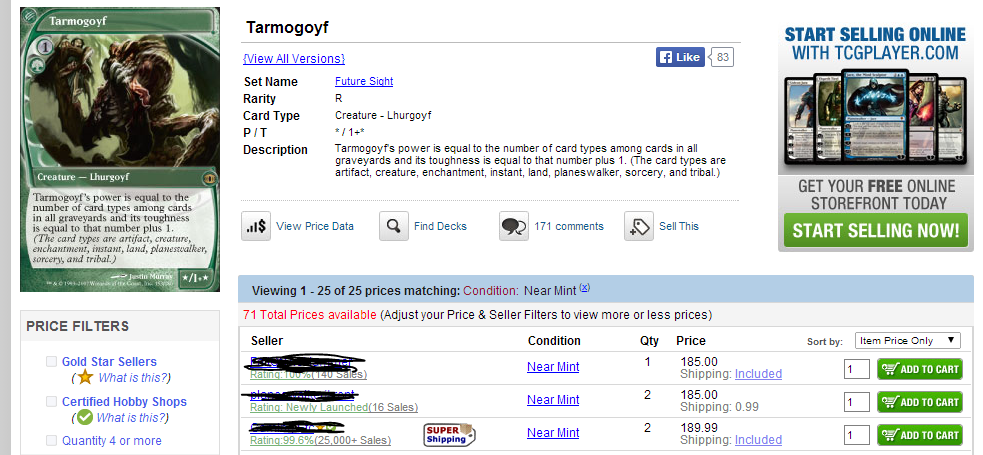
I’m known at my local store as a finance guy, and subsequently get asked how much cards cost frequently. “Travis, how much is Courser worth?” I’m never quite sure how to answer this question. Worth is a funny concept. We’re so used to bandying the term around, but what does it really mean? When I’m asked “how much is Tarmogoyf worth now” what am I supposed to draw upon to answer that? Take a look at the price of Tarmogoyf on Starcity and TCGPlayer.

Capture

Capture1

The exact same card, exact same condition, is $200 at SCG and $185 on TCG. The question remains: it worth $200 or $185? Sitting in front of your computer right now, knowing that the card is available for those two prices, what is the right answer? One could argue that SCG’s higher price reflects their customer service, reliability, and all the other intangibles. But does that affect the actual value of the card? If you’re talking about trading for a Tarmogoyf at a local Modern event should SCG’s additional services dictate that you throw another Courser of Kruphix into the pile?

Why does a Modern Masters Tarmogoyf cost over $165 while a Swordwise Centaur is left behind on card tables worldwide without a single thought given to keeping it? They’re the same quality of cardboard. If you manage to wring all the ink out of the cards you’ll find that neither uses appreciably more. The actual physical presence of the cards, disconnected from whatever demand Magic players place on them, is essentially identical. Without people to place different amounts of external demand on the cards they are worth the same. To say a Tarmogoyf is worth $200 while a Swordwise Centaur is worth $.02 means that there is much more to worth than the physical components. This seems obvious enough, but it has implications that we don’t always appreciate.

Take the young girl from the example above. She wants that Hellkite something fierce. The card represents something that many of us find incredibly difficult to experience after so much time invested in the game. Money means little to her. Cards are valued based on how easily they kill the opponent and how many kids in her grade own a copy. Utvara Hellkite is a card spoken of as a legend amongst her peers. She would immediately have the best deck of all her friends were she to acquire the dragon. The Temple of Enlightenment is essentially valueless. She will never use it. It will collect dust, the edges exposed to wear as it is jostled around in shoeboxes and backpacks. Eventually it will be thrown out when she moves on from the game and her father is cleaning out the attic. To her the dragon is easily worth more than the land. The dragon represents all that is exciting about Magic. But the Temple? What does she care? In her eyes the answer is crystal clear: The dragon is worth far more than the land.

The reason why an object’s worth is so difficult to pinpoint is that it is entirely contextual. If you’re just doing some light trading at an FNM, a Scalding Tarn is probably ‘worth’ the $80 MTGPrice says it is. When it’s early Saturday morning fifteen minutes before the PTQ starts and you still need one for your deck, I bet it’s ‘worth’ more than just the $80 to you. You’d trade $85, $90, maybe even $100 or more for it if it’s necessary for your deck. I remember paying $2 apiece on Might of Old Krosa’s at GP Chicago last year when they were $.40 on TCG because even though I was paying five times what I would online, in that moment they were easily worth the markup because without them I couldn’t play Magic.

Value is found in all of this by identifying what worth means to others. Aside from the most veteran traders, most of us have cards in mind that are worth more than their sticker price indicates. It’s a card we really need to finish foiling an EDH deck or it’s the last dual to finish a playset for an in-the-works Legacy deck. Whatever it is, when we find it we’re often willing to give up more than retail because having the card in our possession is worth more than the markup we pay to acquire it.

Worth is more than the dollar value assigned to a card by any given retailer. Worth includes the time, the day, the location, the temporal necessity, the experience, the story. Understanding in what ways worth is transient and nuanced will help you make better trades and purchases.

Humility is $17.11 on MTGPrice right now. Courser of Kruphix is $16.30. Which card is worth more? Which would you rather have in your binder on Friday at 5:45pm?