Category Archives: City of Traders

An Open Letter

ADVERTISEMENT:


By: Travis Allen

Did you ever tell a family member – any family member at all – that you were at all interested in art of some sort when you were younger? Painting or drawing perhaps? It’s pretty common for kids to be drawn to art early on, even if very few stick with it. It’s a creative outlet and a way to produce a lasting piece of work that they can feel good about days or weeks later.

If you ever mentioned enjoying artwork to an aunt, an uncle, or a grandparent, you know what came next for the following ten years. Art supplies. Every single year. Except they were crummy and unusable every single time. It’s sort of a catch-22. Anyone willing to spend enough money on you to buy you high quality pens or paint supplies would know you well enough that they would know better than to waste their money that way. And yet like clockwork, every Birthday and Christmas, some ten dollar set of markers would show up on the doorstep for you to toss into a box with other unused gifts while you went back to playing Super Nintendo.

While we may have considered this a complete loss of value when we were younger, time has provided us a perspective on the situation a bit more sympathetic with those relatives. To their credit, they were using their limited knowledge of our passing whims as best as they could to provide gifts they thought would be appreciated. If you’re somehow still bitter about this, ask yourself what you really know of the passions of your nieces and nephews, or hell, even your siblings. Providing someone with a meaningful gift that they will truly appreciate is damn difficult, even for those you are closest to.

In order to see what this has to do with us, just replace the word “art” with “Magic” and “paintbrushes” with “Magic cards.” When you’re a child, getting booster packs of cards is thrilling and exciting. I fondly remember cherishing every booster pack of X-Men trading cards I received back then, and getting an entire sealed box for my birthday is one of the few memories I have of early birthday gifts. These days however, gifts including Magic cards are far less special. The issue is that there’s no longer mystery or excitement in the gift of Magic cards. The veil has been pulled back, and as you sit there reading this article, you’re fully capable of going out and purchasing them for yourself. In the next ten minutes you could have any Magic card or sealed product you wish rushing towards your door. It may not be a financially prudent decision, of course, but still, the option is available to you. It’s sort of like ice cream cake. The age at which you can just go buy an ice cream cake for no reason whatsoever except that you want to eat one is exactly the age when you realize it is a terrible idea to do so.

And so we find ourselves the recipients of Intro Decks and booster packs from last year’s core set from well meaning relatives who know little more of our hobbies other than “that card game.” We say thank you, hug the relative, and tell them that it’s so great they provided such a thoughtful gift. Meanwhile you’re staring at that Celestial Archon in the front of the packaging wondering if Target will give you store credit for the intro deck without a receipt.

ADVERTISEMENT:


We feel bad. We really do. They obviously are trying. They mean well. They just…don’t quite get it. It’s like listening to your mom try and describe what you do for a living. How can you be upset when they mean well? It’s in everyone’s best interest if the Magic gifts cease though. They’ll stop spending money on something that’s going to be immediately returned or collect dust in a closet, and you won’t have to feign appreciation for something that is entirely wasted on you. That way you can all get back to giving and receiving the best of gifts: socks. (That’s not a joke).

ADVERTISEMENT:


Today I provide you with a tool. A letter. It is an open letter to friends and family that attempts to gently persuade them that their love can be better channeled. If you’re the non-confrontational (read: passive aggressive) type, just link it on your Facebook wall. For a more direct route, print it out and stick it in the envelope with a thank you card you most certainly haven’t already sent for the last gift they gave you. I’ve provided multiple selections on certain sentences to provide for the most personal touch possible. Feel free to edit and tweak as necessary.


Dear [Friend/Aunt/Uncle/Grandma/Parole Officer],

I hope this letter finds you well. I know we haven’t spoken in awhile, but my [mother/father/dog] tells me you are doing [great/terribly/cocaine]. That is [wonderful/a shame] to hear. I’d ask you what the weather is like there in ___________, but given that I have internet access, it feels a bit silly to ask. It’s funny how the medium of communication dictates how much and what is acceptable small talk.

My reason for sending this letter today is a tad delicate. I should preface the content with sincere thanks for all you have provided me over the years as a loving [relative/friend/parole officer]. I cherish the time we have spent together in the past and look forward to many more lovely [hours/outstanding arrest warrants] in the future.

This past [birthday/Christmas/President’s Day/Tuesday] you gave to me a heartfelt gift that included Magic: The Gathering cards. I was touched to see that you cared enough to purchase a meaningful, personal gift for me. Your love and affection shone brilliantly through your action.

It is this particular gift that I wish to speak about today. While the meaning and thought behind the gift were fully and truly appreciated, the actual content did not quite achieve the [excitement/sexual arousal] you may have hoped it would.

Magic cards behave as a commodity, just as gas, silver, and corn do. While silver and gold [and corn] make for some truly remarkable gifts, a simple few ounces of gold without form or function makes for a much less special treat. It is unlikely you would give someone gasoline as a gift, and Magic cards are not much different. Commodities make the world go round, but any particular instance of such is not particularly special or endearing.

One piece of silver lacks distinction from another until it has been crafted into a piece of jewelry. Similarly, there is nothing unique about this Magic card compared to another of the same name. Nothing exists to distinguish it as my Magic card. The result is that cards change hands often, and a card gifted today could be traded away to peers for something more immediately useful only days later. Furthermore, market shifts can and do happen in the world of Magic just as they do on the real commodities markets. A box of cards you spend $10 on today may be worth less than half of that by the time I actually receive it. The only person who wins on that day is the retailer.

This is not to say you should never purchase any Magic cards ever again. A single booster pack, retail $3-$4, is a pleasing trinket or accessory to another package. (Be sure to ask the retailer for the most recent set!) If you travel abroad, foreign booster packs of cards are much appreciated, not only due to their exotic nature, but as a token of a journey you wish to share. (Russian and Japanese especially so!) In general though, I ask for both our sakes that you mostly refrain from choosing Magic cards as gifts. While I know full well that you mean only the best, at the end of the day they lack the ability to strengthen emotional bonds in a way that many other gestures are capable.

My message today is not one of annoyance or complaint, but rather one of honesty and compassion. I look forward to spending many more enjoyable [holidays/nights in jail cells] with you.

[Love/Sincerely/Dictated but not read by],

_____________________________

Track your collection's value over time, see which cards moved the most, track wishlists, tradelists and more. Sign up at MTGPrice.com - it's free!
ADVERTISEMENT:


Common Cents

By: Travis Allen

Money for Nothing

If you’re anything like me, you are constantly on the lookout for collections to gobble up. Your ears perk up when people talk about getting out of the game, you browse Craigslist for people offloading their kid’s old box of cards, and upon hearing someone comment that they used to play you immediately begin an inquisition into the whereabouts and age range of their cards. The end result of this is that you end up purchasing collection after collection. You strip it for the rares and foils then shove the boxes into a corner. Pretty soon, you have thousands, if not tens of thousands, of lands/commons/uncommons with which you don’t know what to do.

The last time this happened to me I listed the entire pile on Craigslist as a great casual starter kit. I was up front about it not containing any duals or money cards, and that there were probably close to no rares. What WAS in the collection was commons and uncommons that spanned the entire range of Magic’s history, from a few odd Beta cards right up through Theros. I listed it for around $400, and someone picked it up because he and a buddy had been playing again and wanted fodder for decks. They certainly got their fodder. (As an added bonus it was a birthday present, and the guy buying it planned to stack all 100,000+ cards up in his friend’s bedroom.) 

Before I listed it I did one final pass. I wasn’t looking for rares though; rather, I was looking for commons and uncommons. You see, the first time(s) through I was mainly looking for rares and money uncommons such as Lightning Helix or Kitchen Finks. The Zendikar box that had Explores, Expedition Maps, and Goblin Bushwhackers? I had skipped all that stuff. I left in the 30 or 40 Lightning Bolts and the multitude of Brainstorms that had accumulated through various eras. This time I pulled out any common or uncommon that looked remotely playable.

By the time I got all the way back through I must have pulled a solid 5,000 cards out, completely and utterly unsorted. I began plugging cards into MTGPrice to check their buylist value. Anything worth $.10 or more was kept, and the rest tossed back into the box. The work wasn’t all that bad really. I put on some ST:TNG and plowed through. Once I knew that the uncommon shard lands from SOA were worth more than ten cents, I didn’t have to look them up every time. Same with all the rest of the cards that kept repeating. After the first 1,000 cards or so, there weren’t too many repeats.

At the end of this process I had somewhere between 2,500 and 3,000 commons that were all worth at least $.10, and much of it worth more. The problem at this point was that it was still totally and completely unsorted, as there were easily over 100 unique cards in the stack. Furthermore, even if I did sort it, buylisting a pile of that size is sort of a nightmare. Sure HotSauce gives $.45 on Crumbling Necropolis, but what if they don’t want twenty of them? What if they only want twelve? Well now I have to see who pays the next highest amount and sell some to them. What if they don’t want all the ones I have left either? Onto a third store. You can see how this could get tedious, especially taking into consideration that unless I did every order in a single day, the buylist requirements could change as I worked through the pile. Then I’d have to ship everything, make sure they gave me how much they were supposed to, and so on and so on. On top of that, had I gone through all of this, I surely would have ended up with some amount of cards left for various reasons.

ADVERTISEMENT:


So I procrastinated. I let the cards sit there in my room for a few months. Eventually an SCG open rolled through town and I figured I’d bring them with me to see what I could get for them. I wasn’t holding my breath but I thought it was at least worth my time to find out. After taking my third loss in Standard on Saturday, I grabbed the boxes from my car and plopped them on the buyer’s mat. I was expecting him to groan and slowly begin ctrl+f’ing the SCG buylist, sorting the cards into various $.10 and $.50 piles.

He opened one of the boxes, flipped through a bit, and told me he didn’t feel like looking all of it up. After a quick scan of the other two 1,000 count boxes he made me a simple offer: $.25 per card. At the end, I pocketed $650 cash for a few thousand commons and uncommons in the span of fifteen minutes.

I’m well aware that I probably could have eeked out a bit more money had I buylisted the entire pile myself, submitting five or ten buylist orders to various websites. Maybe I could have even got an extra $100 out of it. But think about it like this – all of that would have taken time and effort. A considerable amount of it, in fact. I’d wager that I would have spent at least four hours organizing all of those buylists, if not more. If you consider that I lost $100 shipping the entire pile at $.25/ea instead of buylisting it individually, and it would have taken at least four hours to do, I paid myself at most $25 an hour. I am completely happy to make that exchange.

The reason I present all of this to you is to illustrate two things. The first is that all those decent commons and uncommons that aren’t quite worth lugging around in your trade binder are still completely worth pulling out of collections. The only thing you should be leaving behind are the bulkiest bulk C/UCs. (Of which, to be fair, will comprise a majority of the collection). Make sure you’re still pulling each and every rare too! This same weekend a pair of friends had accumulated bulk rares over the last few months from buying binders from people, and ended up getting a crispy mint pair of Revised Underground Seas for them. (I personally have been keeping all my bulk rares. They’re never going to be worth less than $.10, so I’m not losing money holding onto them, and every now and then when a card spikes to $5-$15 I get to dig through the box and pull a few copies out. Disrupting Shoal, Fist of Suns, Genesis Wave, etc).

Perhaps more importantly, it’s worth it to appropriately value your time. The amount of effort it would have taken to wring a few extra bucks out of all of that would have doubled, tripled, or even quadrupled the amount of time I had put into it. Screw that. Recognize that your time has value and that it’s perfectly acceptable to forfeit some amount of capital in exchange for your entire Saturday back. Whenever you’re thinking about investing a large amount of time into an activity whose sole purpose is to make you money, consider how much you’re making per hour. When it comes to things like sorting bulk commons, chances are it would be more lucrative to simply work a side job on the weekend.

Current Events

I’ve started trading my extra Liliana of the Veils. Her price has been fairly stable since early this year so I’m not expecting any big movements out of her in the near future. She may gain $10, but I don’t think we’ll see her climb above $80 or $90 TCG anytime soon. There are two reasons I’m looking to trade her right now. The first is that there were comments that she was initially in the file for M15. She was pulled for power level reasons (duh) but it shows that Wizards is looking to get her back into our hands. I don’t think we’ll see a reprint in Khans, but with MM2 looking so likely, and that being a perfect place for her, I’ve decided to start shopping her around. I’m not advocating any fire sales, but I’m happy to take Theros staples for her right now that are guaranteed gainers in the next few months.

People continue to clamor about fetches in Khans. Real quick, what I feel is one of the best reasons we won’t see them: Fetches came around last time with landfall. Both were wildly popular. Wizards wants to bring back both. Because of the five-tribe nature of Khans it can’t support landfall as a major mechanic. Since landfall wouldn’t fit well in Khans, they’ll hold it (and fetches) for a set that will better support both.

Buy Temples.

No, buy more.

Eidolon of the Great Revel wrecked my face in Legacy this weekend. Burn decks have always been tier 1.5 to tier 3 budget decks in Modern and Legacy. Eidolon is a big bump in power for them in both formats. Foils are around $20-$25 right now. At those numbers I’m happy to trade for them. I could see them at $30-$40 within a year. 

Nissa, Worldwaker is the truth. She’s hanging strong at $30+. I expect she’ll dip, but I also think it’s unlikely we see her below $20 before the end of the calendar year. If you want a set, go ahead and trade for her. I will be.

Finally, this isn’t necessarily finance related, but I have a platform so I’m going to use it dangit. Wouldn’t Leyline of Anticipation be great in those Modern discard-heavy decks people are always trying to make? Think 4x Thoughtseize 4x Inquisition type decks. They can frequently tear the game apart in the first three turns but often lose to a Tarmogoyf or Bob off the top of the deck while some one-mana discard spell rots in their hand. With Leyline in play, you can cast those discard spells at the end of their draw step just like you would Clique. Leyline turns all those awful late-game Thoughtseizes into much more potent spells, as you can actually nab anything they draw before they cast it. Those decks often run Liliana or Smallpox or something similar, and are constantly discarding their own stuff, so pitching redundant Leylines would be fine. Drawing a late Leyline when you already have one in play is obviously bad, but now instead of having eight to twelve dead top decks in the form of Thoughtseize and Duress, those are all live and only the three other Leylines are dead. That seems like a solid trade. I doubt this makes those decks tier 1 contenders or anything, but it just struck me as an unusual card choice that could actually do a lot to shore up the problems those types of lists tend to have.

PreTQs, PTQs, and PTs: QQ

By: Travis Allen

Did you catch Pro Tour Magic 2015 this weekend? It was Standard (inexplicably), and UW came out as top dog. The experience of watching the later rounds with Ivan Floch may have been familiar to those who watched Cifka win the Modern PT a year or two ago with Eggs, in which he had “won” the game but it was going to take ten to thirty minutes to execute the actual kill. Overall the entire thing was clearly defined by Sphinx’s Revelation and Thoughtseize. We didn’t learn too much useful information about what Standard will look like post-Ravnica, although it looks like Nissa is pretty legitimate. Ichikawa ran the full set with only nine forests in his deck to great success, so apparently the floor on how many forests you need for her to be good is quite low. Yet the biggest news of the Pro Tour wasn’t the cards or the decks, but rather, Organized Play announcements.

Helene Bergeot and the Organized Play (OP) team often use Pro Tours to roll out changes to the OP program, and this weekend’s Pro Tour was no different. The OP program encompasses things likes Grand Prixs, Pro Tours, Pro Tour Qualifiers, etc. This is the team that determines how many slots the PT has, how many pro points should be distributed on average at GPs, what constitutes silver/gold/platinum player levels, etc etc. At PTM15 there were changes made to GPs, PTs, and PTQs, with the PTQ change having the widest, most immediate effect on the most players.

Splitting the Baby

If you’ve been to a PTQ in the last year you’re probably aware they’ve been getting out of control. Qualifiers in Toronto have been easily clearing 200 players, and last year there was one that cleared 346 players or something obscene like that. Early GPs would have been easier to win than some PTQs are today. Clearly, a solution was needed. WOTC has decided that the way to tackle these monstrosities is to divide PTQs into two components, a local PTQ qualifier (PreTQ), and invite-only regional PTQs. Without just copy/pasting the article on the topic, the general idea is this:

  1. Any local store that could run a GPT can now run a PreTQ once per season.
  2. If you win a PreTQ, you qualify for a once-per-season regional PTQ. (There are sixteen in the US).
  3. If you top four (or top eight if there are >128 players) a regional PTQ, you win an invite to the PT and the airfare to haul you there.

The local grinder is going to find themselves in a situation where they’re attending three to maybe nine or ten PreTQs a season, depending how many stores in their area are able to run them and how far the player is willing to travel. Keep in mind there are sixteen weeks each season. Between SCG events, GPs, GPTs, and the new PreTQs, the dedicated player could be competing in competitive REL events nearly every weekend of the year.

On a side note, for the first time ever, I’m personally finding that instead of my quantity of play being gated by the frequency of events I can/want to participate in, I’m instead concerned about the entry fees of so many events. PreTQs will likely be $20-$40 depending on whether they’re constructed or Sealed. Between ~$30 PreTQs, $40 GPs, $80 SCG weekends, and the expenses of travelling to all of them, playing Magic is getting brutally expensive. If you’re good enough to be regularly winning prizes at the events you should be able to come out ahead, but that isn’t going to be the case for the majority of players.

In conjunction with the frequency at which players will be able to participate in PreTQs, there’s another important component to this. PreTQ seasons are not tied to specific formats. That means that any time a store runs a PreTQ, they have the choice of making it Sealed, Standard, or Modern. Aaron Forsythe has said specifically that if they find the distribution does not line up with what they’d like they will take the reins of PreTQ formats, but for the time being it’s up to store owners to decide which format is best for their store.

Regional PTQs will still have their formats locked in by WOTC, but financially this is far less relevant than the free-form PreTQs. Because store owners can choose whichever format they like, there will be Competitive REL events in both Standard and Modern all year round. Gone is the Standard/Modern PTQ season and the increased scrutiny/prices they demand from the market. Instead, there is now going to be a much smoother demand for format staples year round.

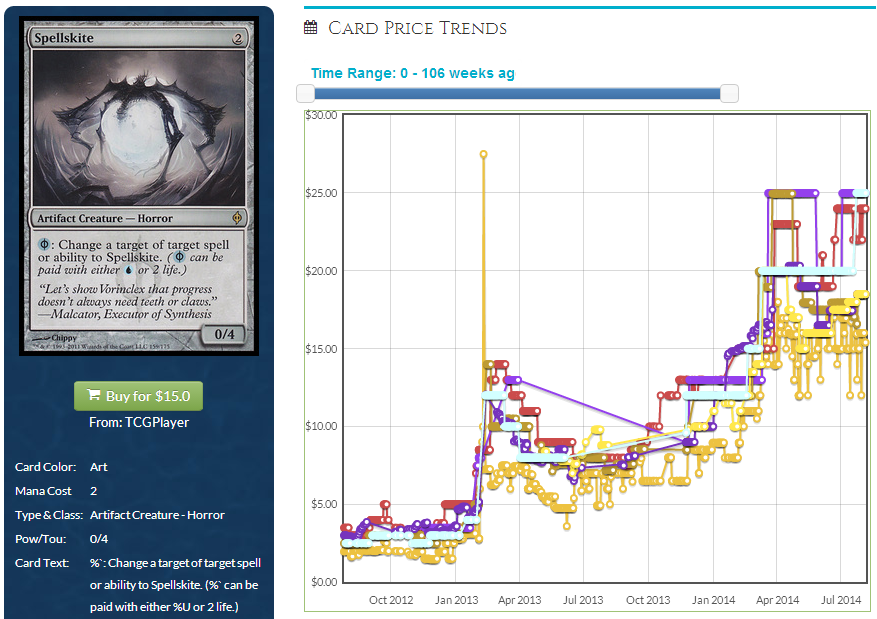
If any random PreTQ can be Modern at any point, grinders are going to need to keep decks together and updated at all times. Instead of trading/selling singles out of season, they’ll be forced to keep them. Format staples like Snapcaster and Tarmogoyf aren’t quite as vulnerable to seasonal changes as role-players, but those role-players should become much more stable. You can see Spellskite’s price bounced around over the last two years as a banner role-player. With constant demand, these rollercoaster prices should be less frequent for well known quantities. You’ll still see wild price rides on flavors of the week that spike and drop drastically, but the cards everyone is already aware of should be much more stable.

spellskite

Standard will see this smoothing as well, although less so since FNM and SCG events ask players to keep cohesive decks together with more regularity. The effect will be most pronounced in Standard after the spring set is released. During the months of May through August (aka now) Standard prices take a real beating for a variety of reasons, one of which is that there’s no real reason for most players to keep up on Standard decks just a few months before rotation. A handful of Standard PreTQs during the summer months will incentivize a lot more players to keep their important rotating staples. It won’t completely shore up drooping interest and rotation fears, but it will help alleviate it.

This new world of constant PreTQs doesn’t seem like the best scenario for those of us looking to capitalize on markets in flux. The old PTQ system rewarded the types of people that kept on top of the cycles and the best strategies to profit from them. In other words, me and you. Annual repetition has been one of the best ways to make profit on MTG if you have patience. Pick up rotating cards, grab staples during the off-season, then ship them when demand rises. With PTQ cycles gone it will be tougher to generate value in that way. It will still happen, of course. Standard staples like the Temples are dirt cheap right now but will assuredly climb in the fall. But those types of opportunities going forward will be less obvious, less available, and riskier overall.

Mirrorweave

Another large change in the OP we need to care about is the standardization of Pro Tours. Or should I say the Standardization. Going forward, all Pro Tours will be Standard.

I find this upsetting on multiple levels. Nothing but Standard PTs means that one PT to the next there will be far less diversity than we have in years past. The decks that do well at the Dewey Pro Tour will look an awful lot like the decks that do well at PT Khans. Does Thoughtseize crush PT Khans? Don’t expect Dewey to change that much. If all four Pro Tours last year were Standard, you can bet your sweet cheeks that Sphinx’s Revelation would have been in the Top 8 of all four. If you hate tier one Standard cards now, you are going to loathe them in short order.

Another facet to all of this is that we won’t be seeing superteams trying to break Modern once or twice a year. Putting twenty guys in a house for two weeks with a singular goal of finding the best deck in Modern is good for the format in moderation. They set the format, identify the pillars, and show the rest of us what to do. Then the general public tweaks the big decks over the following months, trying out new cards in their established decks until the next Modern PT when the pros reassess what the last few sets added. Even if it hasn’t felt like it lately, Modern PTs definitely have an impact on the format. There are eight cards on the Modern ban list that weren’t there at the formats inception, and all eight bans can be traced back to their respective performances in a PT. PTQs aren’t getting cards banned and changing the format. Without a Modern PT, the format is going to be considerably more stale, which will lead to less interest and less breakout cards. 

The most financially troubling part of all this is that we lose the Block Pro Tour. The Block PT has always been an odd duck, as it’s the only high level event that normal players never encounter. As removed as it is from the general player, watching it is a lot of fun and the information it provides is invaluable. Seeing what succeeds at the Block PT is a huge indicator of what the format will look like post-rotation. Without Block, we’re going to have trouble identifying which cards are the true key players in the upcoming Standard.

To see why this matters all we need to do is look back a few days. There were only a handful of unique M15 cards that showed up in the Top 8, and the painland cycle makes up roughly half of them. What M15 cards will matter beyond the lands and Nissa? PT M15 certainly didn’t tell us. If PT Journey had been Standard, we’d have no idea what this coming Fall would look like. PT Journey put Courser of Kruphix, Sylvan Caryatid, Kiora, and more on the map, giving us insight into what would be good once Khans hits. Obviously nobody expects those Block decks to translate, but it allowed Theros stars to shine without being drowned by Sphinx’s Revelation.

Without any of this information it’s going to be much more difficult to identify the fall pillars through the noise of the old set. Next year we are going to be a lot less sure about which Khans cards are going to be big role players once Theros rotates than we are sure about the Theros staples that will be good as Ravnica rotates. The silver lining here is that if you’re very good at predicting power levels you’ll be able to identify the Coursers when they’re only $2 and make an absolute killing when they inevitably hit $15+. Of course this is exceptionally difficult, and even the best don’t manage to identify the pillars consistently. Those that can read the format well will make even more money than they have been with fall rotations, but it will be much tougher for the average player to wring value from Block results.

The new PTQ system smoothes demand curves, removes annual price cycles, and obliterates many small vendors, leaving them with no good way to buy and no good way to vend. The PT change means we have less overall interest in Modern, less top Magic pros working on finding awesome Modern decks, and less information about fall metagames. Overall I’d say PT M15 was pretty bad for those of us interested in making money on cardboard.

Unobtanium

By: Travis Allen

I started playing Magic in 1993 or 1994; I forget which. I was young, as most of us would have been back then. This was the era when people unironically spoke of uncles that worked for Nintendo and Sega and claimed knowledge of special cheat codes that would make the characters in Mortal Kombat strip off their clothes. We played Magic at lunch mostly. Unsleeved decks with wildly imbalanced mana:spell ratios. I’m positive the decks were of no particular size. Card selection rarely moved beyond “all my green cards and black cards.”

What was amazing about this time was the total lack of information. The term “big data” is thrown around so much at academic conferences these days that it’s become embarrassing to genuinely use the term. In 1993 though, you knew nothing beyond your local playgroup. On the rare occasion that someone somehow obtained more cards, perhaps receiving a single booster pack as part of their birthday gift, you poured over them eagerly excited to see what other pieces of this giant puzzle existed. It really was a sensation that is so difficult to capture these days. It’s probably why I enjoy Dark Souls so much. It captures much of the “I have no idea what is happening and I love it” sensation from days past.

To this day I find I carry a strong visceral reaction to certain cards. It’s difficult to describe. Leviathan is probably the single card that best captures my memories of the game. Looking at the image on magiccards.info doesn’t really do it for me. I need to hold the cardboard in my hand. Copies from The Dark work best. When I grasp that card and gaze into it, attempting to lose myself in it’s aesthetic, I experience flashes of nostalgia that I can’t get manage anywhere else. Sometimes it’s the white font against the blue background, readability not a part of the lexicon of design back then. Perhaps it’s the way the tail disappears back behind the lighthouse, perplexingly descending from the clouds in a manner incongruent with your expectations a giant sea creature. It may be the offset mana symbols due to less printing oversight or the contrast between the ancient frame and the faded black border.

Regardless of what element of the card catalyzes these flashes of buried nostalgia, I find myself drawn to the original border. It is an icon of days faded, forever imbued with character and design flaws and mystery. The new border is fine, yes. It’s cleaner, easier to read, and meshes better with advancing mechanics. But it will never have the mystique and history of the original border. Whenever people tell me they prefer the new border I always feel a little sad for them, halcyon memories of childhood inaccessible with a simple piece of cardboard.

The result of all of this is that I acquire foil old border cards wherever possible. They help capture part of the magic of Magic for me. Mixing the history of the original border with the luxury of foils is my favorite way to collect. When was the last time you saw a mint foil card from any of the old sets? They are brilliantly shiny in a way that new foils completely lack. Some of the most beautiful Magic cards in existence are old border foils. (Henceforth OBFs.)

Normally when a new set comes out I’ll scan the spoiler for reprints, see if they had an older printing, and grab foil copies where possible. Off the top of my head I’ve got full or partial sets of Lay of the Land, Ray of Revelation, Llanowar Elves, Lightning Bolt, Last Breath, Worldly Counsel, and Naturalize.

When M15 was spoiled my process was no different. As soon as I saw the painlands I took to TCGPlayer to scoop up my foil Apocalypse copies. Let me tell you, “painland” could not be more appropriate.

Capture

Oof. $30+ apiece for a land legal in Standard for a single year that I may never actually have the chance to put into play. The worst part of this is that they aren’t getting any cheaper. Ever.

Possibly the most rock-solid place to invest your MTG funbux are OBFs. They may not rise quickly or often, but it is virtually impossible for them to get cheaper. No matter the card, copies will be limited by today’s standards. If they’re reprinted, the new copies will be in a different border, placing no strain on the original copies. Heck, as we can see with the painlands, reprinting of old cards actually makes the foils rise. Suddenly those foil Apocalypse Battlefield Forges that were listed at $6 forever are Standard legal and worth $20+ apiece.

Nearly every OBF is a great pickup simply because they have nowhere to go but up. Have a playset of foil UZD Yavimaya Elders? Great, it’s worth $60. If they get judge promo’d know how much your set of UZD ones would be? $60. If they get printed at common in M16 know how much your set of UZD ones would be? $100+, easily.

Demand for OBFs is not rooted in playability, but collectability and luxury. People collect them because they’re beautiful and original and unique, not because they need them to play a tournament. M11 Lightning Bolts are a buck. The only OBF of the card is $250. This is really what makes them the bastion of value that they are. It would be incredibly difficult for Wizards to print something that would devalue these cards. You think the Onslaught foils of Flooded Strand and Polluted Delta are expensive now? Wait until they show up in a fall set.

All of this leads to a simple but painful conclusion. The best time to buy an OBF is now. Whether you’re reading that sentence on 7/23/14 when this article goes live or three years down the road in 2017, it is still accurate. This conclusion is painful because many of these cards are already astronomically expensive. Those ONS foil Flooded Strands are $300, but the fact of the matter is that they aren’t getting cheaper. If you want them, acquire them sooner than later. This time next year one of two things will be true. They’ll either still be $300, or they’ll be $500+ because they were announced for the fall set. The one thing that won’t happen is that they’ll be less than they are today. Maybe you’ll be in better economic standings next year so you decide to wait, but just remember that you’re playing chicken with a train that you can’t see coming.

The absolute best place to go of course is actual reserve list OBFs. Reserve list cards are already gold, and grabbing OBFs – of which by my quick and almost assuredly inaccurate count there are under thirty – is icing on the cake. Just start at the end of this list and work your way backwards. What are some of the best choices?

Replenish – EDH staple and Legacy combo piece. Just because it’s not busting Legacy open right now doesn’t mean it can’t down the road.

Rofellos, Llanowar Emissary – Absurdly powerful legendary creature in one of the most popular tribes of all time? Can’t go wrong.

Metalworker – Inspires entire combo decks in Legacy and enables shenanigans in EDH.

Academy Rector – Another dormant Legacy combo piece that’s also popular both in EDH and casual circles.

Palinchron – EDH staple and generator of infinite mana.

Grim Monolith – EDH staple, Legacy and Vintage busted mana acceleration.

Deranged Hermit – Possibly the wackiest OBF on the reserve list. He’s the godfather of a silly beloved tribe that will always have a place in the heart of a subset of players. 

Old border foils are some of the most visually striking and iconic cards in the game. Their supply is miniature and chances of price surges reasonable. If reprinted they will gain value, not lose it.The worst case scenario for any of them is that Wizards reprints them in the original border ala Timeshifted cards, but even in that case it would merely slow their growth, not decrease their value. If you’re like me and you love the look of old border foils, now is the time to start buying. It’s painful, but it’s only going to get worse.