Category Archives: The Gilded Goblin

Ancestral Recall: The Wild West

ADVERTISEMENT:


Jared is on vacation this week, so enjoy this article that originally aired December 23, 2013.

By: Jared Yost

Sometimes it feels like we are in the wild west of Magic: the Gathering when it comes to sudden price spikes and card buyouts that seem to affect the market on a weekly basis. It feels like every week I am hearing that this card or that card was bought out and the price has gone up 200%-400%. Just like a shootout, it seems as if the first person to draw their gun (or in this case, their wallet) and fire (click “add to cart”) is the winner. And it only seems to get worse as time goes on. 

Disrupting Shoal

ADVERTISEMENT:


Let’s ponder for a quick minute – who the heck is actually pulling the trigger on these calls like Disrupting Shoal and Phyrexian Obliterator (which even seemed to spike twice?) Is it individuals that have amassed enough ammunition (money) and have good enough aim (experience) to hit every single target faster than the rest of us? Are they the Billie the Kids and Jesse James of the Magic market? Is there a domino effect of casual speculators with more money than sense?

The answer is probably yes to both. As the popularity of Magic increases, it looks like the sky’s the limit for the prices on some of these cards when someone discovers that they are undercosted and acts quickly to drain the market. If you are one of these individuals, my hat is off to you. Congratulations. You have done your homework, discovered an undervalued asset, and have capitalized on that asset. I’m not sure if there is any advice I can give you except to avoid the trap of getting in on a card too late, which you’ve probably avoided in 95% of the cases (there is always the potential for the double spike, though it doesn’t happen often – Jace, the Mind Sculptor did it in Standard). Just remember to strike while the iron is hot: those Disrupting Shoals aren’t going to sell themselves.

But It’s not even Modern cards that are experiencing these price hikes. What about cards like Wheel and Deal and Forced FruitionNekusar hasn’t been out for long and isn’t even the flagship commander of the Mind Seize deck, so why did these random cards that only fit into a narrow strategy in a specific causal format go up in value? I might have an idea.

Those holding the bag of cards that spike and then quickly plummet are similar to the penny stock investor, who decided “investing” in penny stock assets would result in a great return. However, the asset in this case is not a random number on a roulette wheel or any single name in a list of penny stocks – the asset is actually something that all of us are emotionally invested in. The first reason that these spikes happen is because players and speculators are both emotionally invested in the game of Magic. Aluren

Everyone that plays Magic is emotionally invested in the game to some degree. Otherwise, why play the game? There are literally thousands of other games that could be played instead, so what makes it so special? The answer is that playing the game is fun, the wonderful community is welcoming and friendly, the feeling of opening packs and sorting a collection can’t be beat, the feeling of chasing a collection and acquiring all of the particular cards you desire is amazing, the great feeling of putting a deck together and calling it your own is the best, and the support by the company that produces the game is fantastic. Without all of these factors, Magic would falter and slowly go away. It is stronger than ever now because all Magic players are able to get emotionally invested through all of these other aspects besides playing the game. There are hundreds of websites dedicated to Magic out there, whether they sell art related to the game (card alters), offer game accessories (dice, tokens, deckboxes, playmats, etc.), or are just reflecting on the community (Cardboard Crack). All of these factors help to cement good feelings in players’ minds about how sweet Magic is.

Right, so what does emotional investment have to do with price spikes? Well, when you get pretty emotional about something, it’s much harder for logic to factor into the equation. Do you want to buy those Disrupting Shoals at $10 because you think they’re cool and there is no way they could go down due to their awesomeness? If this is your train of thought, speculating might not be for you. Speculating requires a certain amount of cold logic and forethought that a lot players don’t want to apply to their favorite past time, which is supposed to be about fun.
Capture

ADVERTISEMENT:


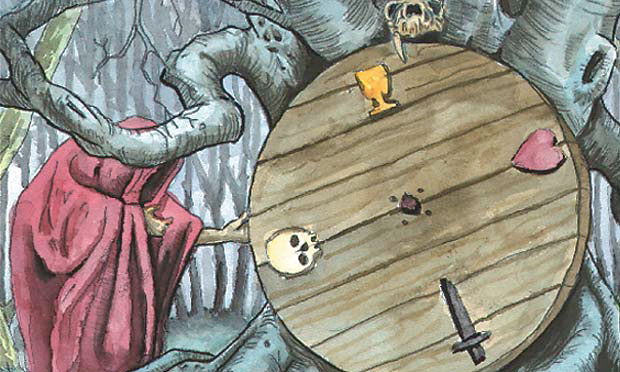
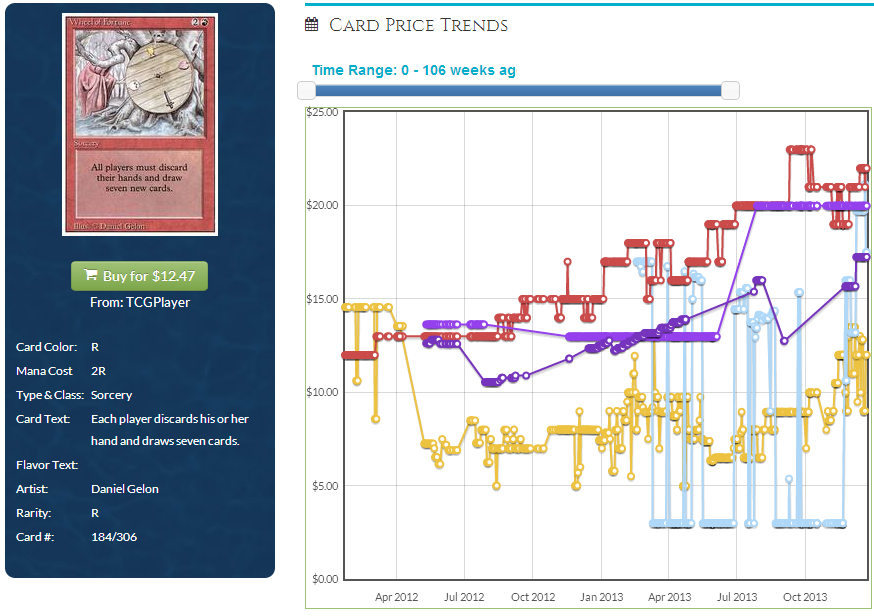
Besides emotional investing, I believe another reason that these price spikes are happening is due to the rarity of the older cards compared to the newer ones (Wheel of Fortune anyone?). Back when Magic first came out, they had no idea how popular the game would be. They created the reserve list out of a fear of killing the game via reprints, and it seemed to work for a time. Because these cards can’t be reprinted, when a new card is released that synergizes or combos well with an old Reserve List card, that card can wind up spiking in value very fast. Even a rules change or unbanning could do this – Gaea’s Cradle and Time Spiral are examples of these cases respectively. With the Modern format Wizards can better control prices of newer cards, but older cards that are in Legacy and EDH are anyone’s guess. 

Nekusar, the Mindrazer

In addition to Reserved List cards that are never getting reprinted, cards that could also receive a reprint but have not gotten one yet are also targets for spikes. Specifically, cards in sets that are post-reserved but pre-Modern, like Masque’s (Rishadan Port), Invasion, Odyssey, and Onslaught – these blocks were printed in a time where the Magic community was only a fraction of what it is today. If a card from one of these sets is discovered to be very synergistic with a new card it, it will spike out of nowhere because the amount of copies that exist are marginal compared to the demand it will see from interacting well with a newer card. It is very hard to keep on top of all the potential combinations that exist without a good grasp on the community resources available to discover these interactions. So I will state that card rarity is always a factor in a spike, because even uncommons (Remand) can become grossly expensive without a reprint.

Just because because a card is rare or hard to find does not mean that its spike is warranted. Aluren would be a good example of this – it’s a card that has a legacy deck to its name and is a casual favorite that a lot of players remember having tons of fun with. It never sustained its price, though, because the deck failed to put up enough results compared to other currently existing legacy decks. Due to the lack of demand, it then dropped down close to the original price from which it spiked. In order to avoid buying high into potential scenarios like Aluren, you want to make sure you pick up the card before it has seen a massive increase in price, you want to make sure that it can fit into a deck that has proven results backing it up, you want to make sure that even if it isn’t tournament playable that it can be popular with casual and EDH players, and you finally want to make sure that it is from a set that had a relatively small print run compared to current sets (like the post-reserve list sets I mentioned above).

So in summary, the combination of emotional investing and card rarity are a recipe for a card spike. Whether the spike is real or whether it will ultimately become a bust can be hard to spot without extensive knowledge of the current tournament scene and correctly identifying the casual appeal of a card. With time comes experience, and I’m sure we’ve all made mistakes in the past in regard to cards and spikes – I certainly have. All we can do is to keep working at it and make sure that the characteristics of a card match up well with the reasons a card could spike. It can sure feel like the wild west at times with all of these card spikes, but realize that many of them can’t sustain those prices for very long and are mainly driven emotional investing and card rarity.

Track your collection's value over time, see which cards moved the most, track wishlists, tradelists and more. Sign up at MTGPrice.com - it's free!

ADVERTISEMENT:


Collectable Reprints

By: Jared Yost

Reprints are a fickle beast. If there is enough demand for a card when it is reprinted, like Tarmogoyf and Dark Confidant when Modern was being pushed upon the Magic community, the market can respond in a frenzied way by spiking the price because of increased demand. Mutavault is a more recent example of this, where it was reprinted for Standard and was the most expensive rare for quite a while because it fit into so many deck strategies. Casual demand is the other reason that cards are reprinted which almost always will result in a price decline.

Today I’m going to focus on the casual demand of reprints by highlighting the new Duel Deck Anthology. Based on the duel deck announcements, I wondered what the most expensive cards from the upcoming duel deck anthology currently command as singles. Gathering some data from MTGPrice we can see that the following cards are the most expensive from the decks.

Card Name Fair Trade Price Best Buylist Price
Demonic Tutor $28.06 $19.25
Akroma, Angel of Wrath $23.45 $12.47
Liliana Vess $12.93 $7.56
Jace Beleren $10.79 $5.07
Garruk Wildspeaker $9.23 $5.00
Ancestral Vision $8.47 $5.19
Counterspell $8.43 $5.55
Chandra Nalaar $7.22 $3.25
Daze $5.22 $3.70
Imperious Perfect $4.96 $2.51
Goblin Warchief $4.63 $3.75
Reya Dawnbringer $4.08 $1.80
Wirewood Symbiote $3.67 $1.51
Luminous Angel $3.27 $1.85
Heedless One $3.23 $2.50
Elvish Promenade $3.06 $1.75
Goblin Ringleader $2.92 $1.50
Wirewood Lodge $2.79 $1.56
Magma Jet $2.76 $1.62
Siege-Gang Commander $2.76 $1.35
Rancor $2.57 $1.40
Twilight Shepherd $2.56 $1.18
Fact or Fiction $2.38 $0.90
Ambush Commander $2.35 $1.01

The first question that pops to mind when I see this list is if they are going to create new art for some of the cards, like Liliana or Jace, or if they are doing strict reprints keeping everything the same except for the new card border. I expect that they are keeping the art the same but let’s pose a hypothetical scenario where they decided to give some of the cards new art.

If they create new art for some of the cards, then I could see many of the current duel decks singles prices dropping 20% or or more. I’ve been fascinated with watching over the years which art of a particular card version the community decides it likes more than another especially when new cards are released. Players love the original Demonic Tutor art but I also hear much praise for the DvD art as well as the judge foil art commissioned. Many times it will come down to personal preference, whether someone prefers a card art due to nostalgia, artistic style, or the subject portrayed in the art. Even still, though there are many different artistic tastes out there, most of the time players can still reach an unofficial consensus of which art piece comes out on top out when discussing a Magic card and its reprint(s).

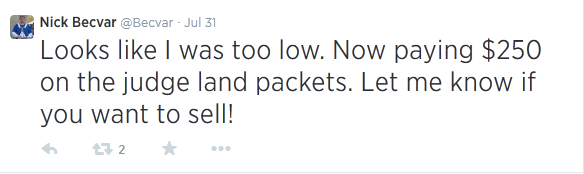
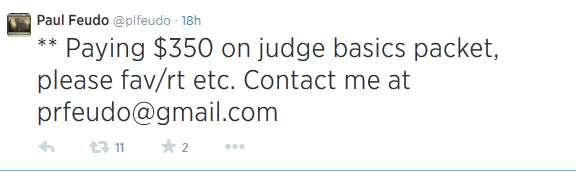
Card art is definitely a factor that boosts the desirability of a card – if you don’t believe me, try and purchase one of the newly released judge foil basic lands.

image00

image02

I’m pretty sure even Terese Nielsen is baffled at what people are offering for these basic lands. Not that I blame them – it’s a smart business decision that will lead to further profits down the road based on the rarity of the lands. Word on the street is that there are only 5,000 of each of these land packets being distributed to judges. That’s on par with the SDCC Planeswalkers, which means you know they are already going to be hard to find. An Arthur Halavais comment on reddit provided an even more pressing case for the expected rarity of these lands:

image01

The uber collector is going to want these for a cube and that means they are going to want as many as they can afford. Based on the price and rarity, whoever that may be is going to have a hard time getting 50 copies of each of these judge lands – but you know that someone is going to try. This is why shops and vendors seem to be scrambling over each other in a mad dash to acquire these lands as fast as possible before people realize what they have.

Circling back to the hypothetical new art scenario, new art could spur interest for cards that receive it. If it comes to light that new art has been commissioned for the flagship cards of this set then I would hold off liquidating any copies of cards you may have from the old duel decks. Wait for community input on the new art, and if the response seems negative than the old versions may keep much of their old value or continue to rise over time. If the response seems positive, or if the art is exactly the same, then it will depend on the card whether the old version will go up in the long run or be suppressed by the reprint.

If the art is the same for the reprints, in other words a strict reprint, my thoughts will differ depending on the card. This is what I think will happen to prices if the art stays the same.

Demonic Tutor – Price decrease. The only reason this card is the most expensive from the first four duel decks is because it is the cheapest black bordered version of the card. Now that even more black bordered versions are going to be flooding the market get out while you still can.

Akroma, Angel of Wrath – Stable price. Still hold onto Akroma for the fact that she is an angel even though she has arguably been outclassed in recent memory by other creatures. Angel collectors are gonna collect and this card is no exception.

Liliana Vess – Price decrease. Along with M15, Liliana Vess is getting yet another reprint in the anthology. I realize that this is a foil version but the market is about to get mass flooded with M15 and then again in December once people start busting open these anthology packs and selling the individual decks. Regardless of art, there are just too many copies out there to justify holding this one.

ADVERTISEMENT:


Jace Beleren – Stable price. Outside of the book promo, this is the next most popular foil version of Jace Beleren. I attribute this popularity to the unique card art of this version because it shows Jace with his hood down versus the other two Beleren art pieces where he is shown hood up. I don’t expect this version’s price to drop much, if at all.

Garruk Wildspeaker – Price decrease. Garruk isn’t nearly as popular as our boy Jace, and this Garruk was printed more than Jace so there are even more of them out there. He’s only around $8 right now and I definitely think that could lower once more are introduced into the market.

Ancestral Vision – Price decrease. Barring a Modern unbanning, more copies entering the market means a price suppression.

Counterspell – Stable price. Counterspell is one of those weird commons that never gets cheaper and seems to maintain its price over the years regardless of reprints. Counterspell has a billion printings and still manages to hover around $1 NM for a common. The only reason that JvC Counterspell is $8.50 is…that’s right, because Jace is in the art. With even more copies of Jace art being printed it will only go down from here.

Chandra Nalaar – Stable price. The only reason I think it will stay stable is because Chandra Nalaar from the duel deck is the only Chandra with different art from the original Lorwyn version. In addition to being foil, the art is fantastic for the JvC version and I think this will buoy the price.

Daze – Price decrease. Common with the same art as Nemesis that isn’t a foil. Expect a significant price drop.

Imperious Perfect – Price decrease. Non-foil version with the same art will drop the price, at least for a little while. Casuals love elves and this card will sustain a $5 price tag in the long run regardless of the three printings it already has. I think you sell now, pick up Perfects once the EvG duel deck is reprinted and then buy back in at the new lower price. Then just wait for it to climb back up again.

Goblin Warchief – Price decrease. Goblins are less popular than elves, so I don’t see Warchiefs price rebounding like Perfects. Sell now before the reprint.

Reya Dawnbringer – Price decrease. I don’t think older copies will dip below $4, especially the Game Day Promo, yet the new version isn’t going to be worth that much based on the Conspiracy reprint price. She just got reprinted in Conspiracy and can barely sell for $1 on TCGPlayer. I don’t think the DvD reprint will be worth $4 like the older versions.

Wirewood Symbiote – Stable price. This is a great card in the Legacy Elves deck, which players might get interested in building if they decide to pick up the EvG duel deck anthology reprint. I have a hard time believing it will fall below $3 retail though if it does I am going to scoop up as many copies as I can.

Luminous Angel – Stable price. Players clearly prefer the DvD art to the Mirrodin art based on TCGPlayer averages so if the reprint art is the same I don’t see her moving from $3 retail.

Heedless One – Price decrease. The only reason the EvG copy sells for $3 TCGPlayer average is because it is much rarer than the Onslaught version, which sells for $1.50. I don’t see this card ever dropping below a $1 due to casual demand but the original EvG copy will drop in price due to this reprint.

Elvish Promenade – Price decrease. Elvish Promenade might be worth more than Heedless One however the price will still drop to around $2 or so with the new reprint. It is an uncommon that has three printings so price is partially propped up by rarity. Like Imperious Perfect, pick up after the reprint and wait for it to go up slowly over time. 

Goblin Ringleader – Price decrease. The EvG copy is around $3 right now, so like Promenade and Heedless One I can see this one going down to $2 as well.

Wirewood Lodge – Stable price. This is a favorite addition to Elf decks and being a land is pretty powerful. I don’t expect the price to move much if at all.

Magma Jet – Price decrease. Already has a ton of printings and just got a reprint in Theros. I don’t expect this to be more expensive than the Theros copy which is around $0.60 TCGPlayer average.

Siege-Gang Commander – Price decrease. The EvG foil is only $3 TCGPlayer average so the reprint is only going to suppress the price. Siege-Gang is a great card but it also had three printings besides the duel deck.

Rancor – Stable price. One of the top casual card aura’s, yet unfortunately its price has been hugely suppressed already by the recent M13 reprint. I don’t see the price up going up though at the same time I think that casual demand will prevent the card from dropping in price.

Twilight Shepherd – Stable price. Again, angel creature type so the casual demand is there. I don’t think this is going to move in price.

Fact or Fiction – Stable price. Just like Reya, the price can’t drop lower than $0.50 to $0.60 for this uncommon but only because it was just reprinted in Conspiracy. Not a reason to move your copies or acquire more.

Ambush Commander – Stable price. It’s only around $1.50 to $1.75 so I don’t think it is going to go lower yet you don’t want to buy in because I don’t think players like their lands being blown up once they become creatures.

My two cents on the upcoming Duel Decks Anthology. Leave a comment letting me know what you’re watching from the set or if you’re planning to get rid of anything before the release.

Saito’s Been Brewing Again

By: Jared Yost

Pro Tour personality @TomoharuSaito has been a busy man. He  has provided the Magic community not one, not two, not three, but thirteen (at the time of this writing) decklists that players can use to get an idea of what Standard might be like until Khans is added to the card pool. He did this for Journey Into Nyx as well but I only found out recently about those Twitter posts he made in May. Some of his May ideas panned out while others did not. I think most didn’t pan out because the top tier strategies are pretty much set in stone at that point, at least in the U.S. Who wants to learn how to play a new deck near the end of the season? The decks did provide insight into several cards, however, and got people talking about cards like Prophetic Flamespeaker which was featured in some of the decks from his last batch. This time around, I’m going to dive deeply into Tomoharu’s decklists and see if we can’t glean any information about which cards might see play after rotation. I think posts like these are helpful in seeing future Standard possibilities.

He displays the decks in an elegant, simple way. He compiled the decklists together on a playmat and took a picture of each list that he thought would see play over the next couple months. Afterwards, a quick post to Twitter and all of a sudden everyone is buzzing around this news. Please check out his lists on Twitter, then come over to this Reddit post to get an idea about what the community is saying about the most recent batch of decks.

From my reading of the Reddit comments players seem to be very divided on how “good” the actual decklists are. Are these only Tier 2 strategies? Is he tricking the entire populace, listing all of these decks out and then going to decide to play something completely different? Could this be chalked up to the uniqueness that is the Japanese Magic scene? We’ll just have to wait and see when the results start rolling in.

From a financial standpoint, these decklists are a powerful tool to let us know the possible directions that Standard could go. Thirteen decks is a lot of data to go through. Let’s see which cards Tomoharu Saito thinks are going to be played the most based on the number of times they appear in each of the decklists. Lets run the numbers and see how many copies of each card are present in the decks.

* – Represents a card that we will see through rotation (commons excluded)

# of Copies Card
56 Forest
33 Mutavault
28 Swamp
27 Plains
26 Mountain
16 Courser of Kruphix*
16 Elvish Mystic
16 Sylvan Caryatid*
16 Overgrown Tomb
16 Temple of Malady*
14 Llanowar Wastes*
12 Thoughtseize*
8 Burning-Tree Shaman
8 Chandra’s Phoenix
8 Desecration Demon
8 Experiment One
8 Lotleth Troll
8 Soldier of the Pantheon*
8 Battlefield Forge*
8 Breeding Pool
8

Mana Confluence*

8 Temple of Triumph*
8 Abrupt Decay
8 Devour Flesh
8 Lightning Strike
8 Stoke the Flames*
7 Boon Satyr*
6 Temple Garden
6 Sign in Blood
6 Ajani Steadfast*
5 Polukranos, World Eater*
5 AEtherspouts*
4 Ajani’s Pridemate*
4 Altac Bloodseeker*
4 Boros Elite
4 Dreg Mangler
4 Dryad Militant
4 Eidolon of Blossoms*
4 Erebos’s Emissary*
4 Firefist Striker
4 Fleecemane Lion*
4 Foundry Street Denizen
4 Galerider Sliver
4 Goblin Rabblemaster*
4 Gyre Sage
4 Kalonian Tusker
4 Lifebane Zombie
4 Liliana’s Reaver
4 Loxodon Smiter
4 Manaweft Sliver
4

Nemesis of Mortals*

4 Nighthowler*
4 Pack Rat
4 Precinct Captain
4 Predatory Sliver
4 Rakdos Cackler
4 Satyr Wayfinder
4 Scuttling Doom Engine*
4 Slitherhead
4 Sliver Hivelord*
4 Soul of Innistrad*
4 Spiteful Returned*
4 Sunblade Elf*
4 Voice of Resurgence
4 Wall of Mulch*
4 Yisan, the Wanderer Bard*
4 Young Pyromancer
4 Hallowed Fountain
4 Maze’s End
4 Nykthos, Shrine to Nyx*
4 Sacred Foundry
4 Sliver Hive*
4 Steam Vents
4 Temple of Enlightenment*
4 Temple of Epiphany*
4 Urborg, Tomb of Yawgmoth*
4 Yavimaya Coast*
4 Banishing Light*
4 Detention Sphere
4 Necromancer’s Stockpile*
4 Path of Bravery
4 Waste Not*
4 Advent of the Wurm
4 Boros Charm
4 Chord of Calling*
4 Dissolve*
4 Druid’s Deliverance
4 Fog
4 Grisly Salvage
4 Izzet Charm
4 Searing Blood*
4 Shock
4 Sphinx’s Revelation
4 Warleader’s Helix
4 Anger of the Gods*
4 Duress
4 Mind Rot
4 Supreme Verdict
4 Urban Evolution
4 Jace, Architect of Thought
4 Kiora, the Crashing Wave*
3 Brimaz, King of Oreskos*
3 Fiendslayer Paladin
3 Firedrinker Satyr*
3 Frenzied Goblin*
3 Pharika, God of Affliction*
3 Shivan Reef*
3 Hero’s Downfall*
3 Drown in Sorrow*
3 Elspeth, Sun’s Champion*
3 Garruk, Caller of Beasts
3 Liliana Vess
3 Nissa, Worldwaker*
2 Bonescythe Sliver
2 Megantic Sliver
2 Voyaging Satyr
2 Stomping Ground
2 Ulcerate*
2 Brave the Elements
2 Ephemeral Shields
2 Golgari Charm
2 Commune with the Gods
2 Restock*
2 Garruk, Apex Predator*
2 Vraska the Unseen
1 Battle Sliver
1 Blur Sliver
1 Constricting Sliver*
1 Hornet Queen*
1 Keranos, God of Storms*
1 Scavenging Ooze
1 Striking Sliver
1 Syphon Sliver
1 Venom Sliver
1 Azorius Guildgate
1 Boros Guildgate
1 Dimir Guildgate
1 Golgari Guildgate
1 Gruul Guildgate
1 Izzet Guildgate
1 Orzhov Guildgate
1 Rakdos Guildgate
1 Selesnya Guildgate
1 Simic Guildgate
1 Reclamation Sage*
1 Call of the Conclave

The decks were quite diverse and the card list reflects this. However, we’re also trying to glean some information as to what cards Saito values the most from Standard sets that aren’t rotating in the fall.

Top 10 Rares Appearing Across Decks Through Rotation:

Courser of Kruphix (16)
Sylvan Caryatid (16)
Temple of Malady (16)
Llanowar Wastes (14)
Thoughtseize (12)
Soldier of the Pantheon (8)
Battlefield Forge (8)
Mana Confluence (8)
Temple of Triumph (8)
Boon Satyr (7)

Honorable Mention:

AEtherspouts

If you’re a Standard player you will want to pick up your copies of these cards because they are the most likely to get played across several archetypes. You’re chances of being able to use the cards once Khans comes up are pretty high if you decide to pick up cards on this list.

Courser of Kruphix, Sylvan Caryatid, and Temple of Malady round out the top three. They appeared in both spike and fringe strategies (fringe examples include Maze’s End and BG Zombies), and when they did each deck contained a playset of them. Llanowar Wastes comes in at a close fourth with Thoughtseize to round out the top five. I would advise picking up all cards at the current prices if you plan on playing them.

Soldier of the Pantheon, Battlefield Forge, Mana Confluence, and Temple of Triumph all appeared as a playset in two decks. Boon Satyr appeared as a playset in one, and three copies in another. These are probably the best cards to spec on, and personally I would put my money on Soldier of the Pantheon and Mana Confluence as the breakout cards of the four. Boon Satyr and Temple of Triumph should also be solid going into rotation but I don’t think the gains will be as good as Soldier or Mana Confluence.

AEtherspouts appeared in control lists that utilized blue. I’m not sure how well these decks were tested, but it couldn’t hurt to pick up a a few copies for EDH or if you plan on playing one of them in something like UWR Control or a similar build.

Cards not in this list but still should be looked out for – Chord of Calling, Urborg, the other Temples, Painlands, Eidolon of Blossoms, Fleecemane Lion, Anger of the Gods, and Scuttling Doom Engine. They each are good enough to merit play as well.

Top 10 Mythics Appearing Across Decks Through Rotation:

Ajani Steadfast (6)
Polukranos, World Eater (5)
Sliver Hivelord (4)
Soul of Innistrad (4)
Kiora, the Crashing Wave (4)
Brimaz, King of Oreskos (3)
Pharika, God of Affliction (3)
Elspeth, Sun’s Champion (3)
Nissa, Worldwaker (3)
Garruk, Apex Predator (2)

Mythics are an interesting bunch. Due to Wizard’s policy of trying to create format staples as rares rather than mythics, we find that a large majority of mythics in this list are played in only one of Tomoharu’s builds. Ajani Steadfast and Polukranos buck this trend, but Polukranos only appears as a Chord of Calling Target in his mono green devotion list. It appears that he will be good in the new green deck based around Nissa.

Essentially, the takeaway here is that Ajani Steadfast probably has the most to gain from rotation if white weenie or green/white aggro becomes a dominant deck over the summer. Though I’m not sure if Ajani is the right walker to put in these decks – I feel like Elspeth, Sun’s Champion is much stronger and I would rather pick her up seeing her on this list. However, I also haven’t been a Magic Pro Player of the Year and everyone could be undervaluing Ajani because they haven’t tested him. Then again, I have no idea if any of these decks have been tested so it’s kind of a hard call at this point. $15 is a little rich for my blood, so if it starts going down towards $8 I think it would definitely be a good planeswalker to pick up. At the very least, if you’re playing white weenie you should be getting Brimaz which the list confirms. 

Sliver Hivelord only earns a spot in this list because people will try to make the Slivers deck work. I have no idea how good it might be but I’m guessing it won’t gain much traction from people outside of FNM. Plus, many of the pieces are rotating in the fall so I’m staying far away from slivers mainly for that reason.

Soul of Innistrad was the only soul mentioned to make it into any lists. Pharika and Keranos were the only gods to show up, and Keranos only showed up as one copy in the UWR control build. I’m not sure if the souls and gods are worse than I initially thought but this might confirm in many peoples minds that they are. I still wouldn’t discount many of them, especially Soul of Theros or Soul of New Phyrexia once rotation hits. Pharika is appearing in lists since she is such a cheap god so I would say getting in lower than $5 is pretty good for her at this point. I think she will see marginal play in the future.

Kiora was only in the Maze’s End list, which means that she doesn’t really have a home yet come rotation. Maybe something will pop up over the next few months. At $14, I don’t really see her going lower so you won’t be making a mistake buying in. I just don’t think she has that much room to grow unless another slow control deck like Maze’s End comes along.

Nissa and Garruk are tough to analyze at this point. Something tells me that somebody knows something about Nissa due to the recent price surge she has experienced over the last week. However, it could just be that a lot of casual players want her as soon as she comes out. Afterall her second +1 ability isn’t that great outside of a mono green deck. Based on these concerns I don’t think her current $35 price tag is warranted. Even Garruk, Caller of Beasts was only around $25-$30 at his peak and he suffered from some of the same issue (second activated ability only worked for green).

Garruk, Apex Predator can only go in those really controlling shells as a finisher from the looks of things. Even with all the ramp in Standard getting out a seven mana planeswalker is tough. Maybe it will be easier with the introduction of Khans but I don’t think it is going to pan out this way. Get rid of your copies for $25 now and pick them up later when they are cheaper.

Trader’s Edge

Twitter posts like these are exactly why you should have an account. Twitter in general provides valuable information to the Magic community and these posts especially can provide the right kind of value to the financial minded. The decklist pictures quickly give us an overview of the new Standard possibilities without each one of us having to do the leg work of putting a bunch of decks together. The hardest part is playtesting which will tell you which cards perform the best in their respective archetypes.

But at least we’re not fumbling around in the dark. At the very least, Tomoharu Saito’s decklists allow the community to have a vibrant discussion on the merits of each deck and which cards are the deck’s frontrunners. Which cards do you think will make the most impact on the upcoming Standard?

I’ll leave you with the notable uncommons that were found in the decks. I’m not one to speculate on uncommons (unless they are extremely undervalued) but these are the top uncommons that appeared in Tomoharu’s decks:

Stoke the Flames  (8)
Ajani’s Pridemate (4)
Altac Bloodseeker (4)
Erebos’s Emissary (4)
Nemesis of Mortals (4)
Spiteful Returned (4)
Sunblade Elf (4)
Wall of Mulch (4)
Dissolve (4)
Searing Blood (4)
Frenzied Goblin (3)
Drown in Sorrow (3)
Ulcerate (2)
Restock (2)

Ancestral Recall: The Wild West

Jared is on vacation this week, so please enjoy this article of his originally from 12/23/13.

By: Jared Yost

Sometimes it feels like we are in the wild west of Magic: the Gathering when it comes to sudden price spikes and card buyouts that seem to affect the market on a weekly basis. It feels like every week I am hearing that this card or that card was bought out and the price has gone up 200%-400%. Just like a shootout, it seems as if the first person to draw their gun (or in this case, their wallet) and fire (click “add to cart”) is the winner. And it only seems to get worse as time goes on. 

Disrupting Shoal

Let’s ponder for a quick minute – who the heck is actually pulling the trigger on these calls like Disrupting Shoal and Phyrexian Obliterator (which even seemed to spike twice?) Is it individuals that have amassed enough ammunition (money) and have good enough aim (experience) to hit every single target faster than the rest of us? Are they the Billie the Kids and Jesse James of the Magic market? Is there a domino effect of casual speculators with more money than sense?

The answer is probably yes to both. As the popularity of Magic increases, it looks like the sky’s the limit for the prices on some of these cards when someone discovers that they are undercosted and acts quickly to drain the market. If you are one of these individuals, my hat is off to you. Congratulations. You have done your homework, discovered an undervalued asset, and have capitalized on that asset. I’m not sure if there is any advice I can give you except to avoid the trap of getting in on a card too late, which you’ve probably avoided in 95% of the cases (there is always the potential for the double spike, though it doesn’t happen often – Jace, the Mind Sculptor did it in Standard). Just remember to strike while the iron is hot: those Disrupting Shoals aren’t going to sell themselves.

But It’s not even Modern cards that are experiencing these price hikes. What about cards like Wheel and Deal and Forced FruitionNekusar hasn’t been out for long and isn’t even the flagship commander of the Mind Seize deck, so why did these random cards that only fit into a narrow strategy in a specific causal format go up in value? I might have an idea.

Those holding the bag of cards that spike and then quickly plummet are similar to the penny stock investor, who decided “investing” in penny stock assets would result in a great return. However, the asset in this case is not a random number on a roulette wheel or any single name in a list of penny stocks – the asset is actually something that all of us are emotionally invested in. The first reason that these spikes happen is because players and speculators are both emotionally invested in the game of Magic. Aluren

Everyone that plays Magic is emotionally invested in the game to some degree. Otherwise, why play the game? There are literally thousands of other games that could be played instead, so what makes it so special? The answer is that playing the game is fun, the wonderful community is welcoming and friendly, the feeling of opening packs and sorting a collection can’t be beat, the feeling of chasing a collection and acquiring all of the particular cards you desire is amazing, the great feeling of putting a deck together and calling it your own is the best, and the support by the company that produces the game is fantastic. Without all of these factors, Magic would falter and slowly go away. It is stronger than ever now because all Magic players are able to get emotionally invested through all of these other aspects besides playing the game. There are hundreds of websites dedicated to Magic out there, whether they sell art related to the game (card alters), offer game accessories (dice, tokens, deckboxes, playmats, etc.), or are just reflecting on the community (Cardboard Crack). All of these factors help to cement good feelings in players’ minds about how sweet Magic is.

Right, so what does emotional investment have to do with price spikes? Well, when you get pretty emotional about something, it’s much harder for logic to factor into the equation. Do you want to buy those Disrupting Shoals at $10 because you think they’re cool and there is no way they could go down due to their awesomeness? If this is your train of thought, speculating might not be for you. Speculating requires a certain amount of cold logic and forethought that a lot players don’t want to apply to their favorite past time, which is supposed to be about fun.

Capture

Besides emotional investing, I believe another reason that these price spikes are happening is due to the rarity of the older cards compared to the newer ones (Wheel of Fortune anyone?). Back when Magic first came out, they had no idea how popular the game would be. They created the reserve list out of a fear of killing the game via reprints, and it seemed to work for a time. Because these cards can’t be reprinted, when a new card is released that synergizes or combos well with an old Reserve List card, that card can wind up spiking in value very fast. Even a rules change or unbanning could do this – Gaea’s Cradle and Time Spiral are examples of these cases respectively. With the Modern format Wizards can better control prices of newer cards, but older cards that are in Legacy and EDH are anyone’s guess. 

Nekusar, the Mindrazer

In addition to Reserved List cards that are never getting reprinted, cards that could also receive a reprint but have not gotten one yet are also targets for spikes. Specifically, cards in sets that are post-reserved but pre-Modern, like Masque’s (Rishadan Port), Invasion, Odyssey, and Onslaught – these blocks were printed in a time where the Magic community was only a fraction of what it is today. If a card from one of these sets is discovered to be very synergistic with a new card it, it will spike out of nowhere because the amount of copies that exist are marginal compared to the demand it will see from interacting well with a newer card. It is very hard to keep on top of all the potential combinations that exist without a good grasp on the community resources available to discover these interactions. So I will state that card rarity is always a factor in a spike, because even uncommons (Remand) can become grossly expensive without a reprint.

Just because because a card is rare or hard to find does not mean that its spike is warranted. Aluren would be a good example of this – it’s a card that has a legacy deck to its name and is a casual favorite that a lot of players remember having tons of fun with. It never sustained its price, though, because the deck failed to put up enough results compared to other currently existing legacy decks. Due to the lack of demand, it then dropped down close to the original price from which it spiked. In order to avoid buying high into potential scenarios like Aluren, you want to make sure you pick up the card before it has seen a massive increase in price, you want to make sure that it can fit into a deck that has proven results backing it up, you want to make sure that even if it isn’t tournament playable that it can be popular with casual and EDH players, and you finally want to make sure that it is from a set that had a relatively small print run compared to current sets (like the post-reserve list sets I mentioned above).

So in summary, the combination of emotional investing and card rarity are a recipe for a card spike. Whether the spike is real or whether it will ultimately become a bust can be hard to spot without extensive knowledge of the current tournament scene and correctly identifying the casual appeal of a card. With time comes experience, and I’m sure we’ve all made mistakes in the past in regard to cards and spikes – I certainly have. All we can do is to keep working at it and make sure that the characteristics of a card match up well with the reasons a card could spike. It can sure feel like the wild west at times with all of these card spikes, but realize that many of them can’t sustain those prices for very long and are mainly driven emotional investing and card rarity.