Category Archives: The Gilded Goblin

Powering Up the Core Sets

ADVERTISEMENT:


By: Jared Yost

Core Set History

As the years go on, we seem to expect more and more out of our core sets. The bar started with Baneslayer Angel when M10 was released. Its debut year in Standard was awe inspiring. I remember being at my local game store drafting M10 and cracking a Baneslayer Angel in a pack. Unfortunately, white was not to be my deck color and my draft went in a totally different direction. I only wound up going 2-2, which didn’t put me into the contention for any prize packs. Regardless, I wanted to get some value out of my mythic so I went up to the counter and wanted to know what I could get for it. “Yeah, we’ll give you $30 for that one” the guy says. I couldn’t believe it! Baneslayer went on to be a $50 card at its peak in Standard and was a significant force in the format.

Sadly, Wizards did not learn its lesson with Baneslayer Angel and instead decided to up the ante by releasing the infamous Titan cycle into Standard with the introduction of M11. Instead of just Baneslayer Angel, we now had to worry about Primeval Titan, Grave Titan, and/or Frost Titan, with occasionally Sun Titan and Inferno Titan making an appearance (how couldn’t they, the Titans are so much value!). The first three titans all saw prices upwards of $30 or more at their peaks (Prime Time being the most expensive at around $45 for most of its Standard life) while the other two hovered in the teens for their peaks. Standard was this time basically warped around these gigantic creatures – and it was even worse because Wizards reprinted them again in M12! We had to deal with these things two friggin years in a row. In my opinion it made Standard pretty stale.

Which is probably why they discontinued the Titan reprints in M13 and instead opted for Thundermaw Hellkite. Yes, finally red got some love! This was the next $45 Standard mythic and it was actually quite balanced considering. Sure, Thundermaw wrecked plenty of face but also remember that in this same format we had Thragtusk and Restoration Angel – the two-faced terror which I’m sure still haunts a few players nightmares. While this time around the mistake was a rare in Thragtusk, it still warped the format pretty badly albeit in a slightly different way than the titans.

ADVERTISEMENT:


Next came M14. Chandra, Pyromaster probably came the closest to being a $40 card but I don’t think it ever quite got there at least not on TCGPlayer. Similar to M13, another rare altered the course of the format. Mutavault is the first time a core set reprint (from the M{XX} sets) has made such an impact on Standard. I believe the intent here was to help Modern players out however I don’t think anyone got the memo that only Merfolk plays Mutavault in Modern. Theros and Return to Ravnica were not exactly tribal themed sets, so Mutavault couldn’t be that insane right? Well with the onset of Devotion it became quite clear that Mutavault was the card of choice to give the monocolored decks the advantage they needed to start becoming dominant.

M15 on the Horizon

Finally we arrive at the upcoming M15. Why did I just spend 500 words outlining past core sets? Because the most expensive rare or mythic in Standard has a good chance of coming from a core set. Wizards has been overpowering these core sets with at least one or two insanely good cards that will almost definitely affect the upcoming Standard. Since the introduction of new cards into a core set, it has become apparent that we need to pay extra close attention to these sets in order to stay ahead of the curve. Even reprints could significantly alter the format for another year.

ADVERTISEMENT:


Wizards brought back the big creature cycle of mythics to the core set but has nerfed it in a significant way. They’ve now replaced the Titan cycle with the Soul cycle which are a set of six avatars that represent the various planes in the most recent Magic mythos. They are all 6/6’s for six mana with an evergreen ability, which makes them similar to the Titans, however this time around you need to tap a bunch of mana to use their best abilities rather just have them come into play or attack. Even though a lot of people probably think this is rather weak, and lets face it we’ve been pretty spoiled with the Titans to not think so, I have a feeling that at least one or two of them will see Standard play. Whether it is significant or not has yet to be seen however the evidence in the past has shown that splashy mythics that see some play will be priced accordingly. Remember, the set release is a terrible time to pick up potential Standard staples so you should wait about a month or two after its release before picking up potential playables.

Perilous Vault is quite spicy. A new take on Nev’s Disk that exiles everything is pretty sweet. Could this be our new crazy Standard mythic? Or how about the new Nissa, Ajani, Jace, or Garruk? We’re getting a reprint of Chandra, Pyromaster and Liliana Vess so nothing new there since we already know the power level.

We’re also getting enemy Painlands and Urborg, Tomb of Yawgmoth! An Urborg reprint is awesome for Commander players but why is Wizards only reprinting the enemy color painlands? Didn’t they just say not that long ago that they were intending to only print full cycles of lands in sets from now on after Innistrad? Wow, that has to be the quickest take back I’ve ever seen from them. It doesn’t bode well for fetchlands – those hoping to get Polluted Deltas on the cheap may be sadly disappointed when they only reprint the Zendikar ones. Keep an eye out for the painlands because even though they are only marginally good historically once they become Standard legal all bets are off. Players will utilize any land they can to get the best mana fixing, even if they have to play a bunch of Mana Confluences in addition to these painlands. Don’t think just because they were $1 before coming into Standard they will stay that low for long. At least one of them is going to spike at some point.

Phyrexian Revoker is making a comeback, which is cool and goes with the mythic Soul of New Phyrexia. This is also a new development since I had previously believed that cards which are very set specific would be fairly hard to reprint. Not that I think Spellskite is going to be thrown into a core set anytime soon but it still makes me more wary of going deep on something based on the notion that its flavor is too specific to see a reprint in a core set.

As usual, the core set is primed to shake things up. Wizards seems hellbent on proving that they are willing to make more and more drastic changes to the core sets as the years go on. First, it was upping the power level of creatures through the creation of powerful, yet cleanly designed, cards. Now it appears they have instead focused on adding unique new abilities and refining the core set to more align with the current mythos of Magic – instead of generic cards, they are now adding specific flavor to the core sets that pulls from recent and future sets. I’m excited to see how this core set pans out and I will be thinking hard about which cards are going to be the most influencing.

Track your collection's value over time, see which cards moved the most, track wishlists, tradelists and more. Sign up at MTGPrice.com - it's free!

ADVERTISEMENT:


Why Magic Cards Aren’t Exactly Stocks

By: Jared Yost

The Financially Savvy Planeswalker

Based on the popular website mtgstocks.com one might be lead to believe that our dabbling in the singles market for Magic cards makes use Magic day traders, so to speak. Yes there are similarities but it is in the finer points of the activities surrounding the stock market where the key differences lie.

First, let me draw to your attention the work that mtgstocks and other websites like it (MTGPrice and Quietspeculation included) have done for us since their inception. They are amazing resources that players can utilize to get up to date information on card prices from the vast majority of Magic cards that are out there. Some even offer additional features, like buy list aggregators that let us know where we can quickly buy list any singles we may have been accruing in order to efficiently sell them off to the various vendors. I regularly use both resources in order to see current market trends and to base whether or not my position in the market is suited to what is currently happening. I also use them to put together buy list orders that enable me to sell off cards in bulk for some orders.

What these websites aren’t are E*TRADE, Charles Schwab, or Scottrade. There are  many fine differences between buying and selling stocks versus buying and selling Magic cards. I’m going to assume you don’t know anything about the stock market and start from the ground up. Let’s use this getting started with the stock market article by Lifehacker as the starting point. You will need to know about the following in order to invest wisely in the stock market:

Learn the Terminology – In other words, know what words like dividends are and what they offer you when you decide to purchase a stock.

How to Pick the Company (Stock) – Now that you understand the terminology you will need to know how to go about picking exactly which stock you want to buy into and how much of it you are willing to purchase. There are generally two avenues for doing this – growth stocks and dividend stocks. I’ll get into this discussion later on because this is the closest comparison you can make between MTG speculation and the stock market.

Research – Find out about any issues at the companies you want to buy the stock from before deciding if you ultimately want to purchase them. Know when to diversify your portfolio so that you don’t get banged up too badly when a stock you do purchase goes south. Research also heavily relates to MTG and and ties into the second point closely. The distinct difference here is that you are not just picking stocks but picking stocks based on their role in the market and the financials of the company behind the stock.

Utilize Tools – Know which tools are right for you in order to get the most out of your experience buying and selling stocks. These represent everything from Yahoo Finance to systems like E*TRADE where you actually purchase and sell the stocks.

Reading that explanation may make you think that MTG speculation is related in basically every facet to the stock market, especially concerning research and picks. While this may appear to be true on the surface, in reality the little details of the stock market and Magic speculation go in totally different directions.

Let’s dive further into stock market terminology. These are just some of the many facets of a stock you can use to determine if you want to buy or sell it:

Stock Price
Earnings per share (EPS)
Beta
Market Capitalization
IPO
Price to Earnings Ratio (P/E)
Hedge
Margin
Moving Average
Exchange
Volatility

I could go on for quite a while, listing all of the possible information you could use to invest in a stock, but the issue I wanted to highlight is that there are plenty of data points that you could use to make a decision whether or not to invest in a stock. With Magic cards, there are also data points we could use to base our speculation on yet I have a feeling that most speculation is based on a gut reaction to a card – hardly something with concrete evidence to back it up without further defining data points. However, by standardizing certain data points about a card we could go down the path of statistically indicating the probability of a Magic card being good and thus being a good candidate to increase in price. Unfortunately, this almost never works because Magic cards are controlled by a single company rather than a market of potentially thousands of companies. This lack of diversity, along with other issues, leads to many differentiating factors that make Magic speculating much different and even sometimes harder than the stock market.

One vs A Thousand

There is only one company that controls production of Magic: the Gathering cards. Unless the market becomes flooded with counterfeit producers, which would not indicate the end of the game necessarily but would still destroy the secondary market, this fact will continue to influence the prices of Magic cards in a significant way. They make the rules for the growth cards by influencing Standard card pools and Modern reprints, and occasionally shaking up the Legacy banlist.

Since Wizards of the Coast is owned by Hasbro, and Hasbro only shares select pieces of information about Magic card production facts and figures, we can really only base our financial understanding of a growth card on past actions of similar cards or from a deck tech article where the author may or may not even play the deck at the Pro Tour. If someone suggested that I should try to buy a growth stock based on this type of information, I would laugh them out of the room. The odds of buying of a single growth stock and making it work this way are no better than going to a casino and hoping to win a million dollars. It is assuredly a losing game when trying to buy several growth stocks like this.

Dividend cards, on the other hand, offer us another look at the Magic market. Dividend cards are your Legacy Duals lands – pretty much guaranteed to go up until the death of the game. Think Black Lotus, Mishra’s Workshop, and Bazaar of Baghdad – reserve list cards that are played in favorite Vintage archetypes that also have collectible value from being so old and rare. The reserve list is the halcyon of dividend cards. If you want to have a comfortable increase in the value of your collection, targeting reserve list cards is the way to go. Unlike stocks, they aren’t as volatile – there are plenty of companies that pay dividends whose stock has dived considerably. Reserve list cards tend not to do this, at least no overnight like a stock might. In this example Magic seems like a better investment than stocks most of the time if you have the capital and storage (bank lock box) to keep your value. Your market is much smaller than a stock, however, so if you want to liquidate your card it could take a while to find a buyer.

This market restriction presents itself in more than just a lack of information. There is also a lack of resources you can use to sell your cards unlike selling a stock. When I’m on a digital broker, I can sell a stock instantly at the asking price it is listed at – and receive my money as soon as that execution is acted upon. With Magic cards, they can sometimes linger for months if no one wants them. Yes, the buy list is always an option – but there you are leaving more money on the table rather than getting the “market price” of the card where in the case of a stock you sell, you get market price pretty much every time. That also doesn’t indicate the hidden fees and time it takes for the cards to get to you. Of course, some brokers charge a fee every time you execute a sell or buy – others don’t though, so if you are interested in stocks it is usually a good idea to look around first to find a broker that best fits your volume of stock purchases and sells. You don’t have this luxury for Magic buy lists. You always eat the cost of shipping to the buy list, which includes the actual act of shipping the cards and the materials you need to ship them and even insurance.

It also manifests itself in the fact that this is a game rather than a financial vessel. Rather than looking at the cards as dollar bills, they are actually things we can use to play with which means they hold sentimental value to us. Vendors have gotten around these pesky sentimental feelings by going through thousands of these cards a month, however for 99% of the player base we got into this game to play it rather than try to make money off of it.

ADVERTISEMENT:


OK, but Card Prices Do Go Up… And Down (Buy Low)… So Profit?

Yes, that is evident and why I’m so interested in knowing why Magic card prices fluctuate so much and sometimes with only a day’s notice. I didn’t say you can’t make money here however you can’t be in the same mindset of a day trader.

Now I mentioned that there are ways of standardizing data points for cards in order to determine their value. Some of the ways could include:

Age (physical age – as in, Alpha cards tend to be worth the most statistically speaking)
Converted Mana Cost
Set Rarity (common to mythic rare)
Number of Copies per Deck
Color
Crowd Favorite (love from the casuals, tournament crowd, and both crowds)
Format It’s Legal In
Card Type (lands and Planeswalkers are generally worth more)
Number of Articles It’s Mentioned In
Preorder Price
Trade Value
Market Value

These are just the first batch of properties I brainstormed. I’m sure there are more we can use, just like stocks, and some of these properties even contradict each other just like stock properties tend to do. For example, a card might have a low converted mana cost and be a mythic but it might be just a vanilla green creature with two power and toughness. Vanilla guys without synergy in the format are garbage. Generally multiple traits are desirable together yet combine them in the wrong way and all of sudden you have a bulk mythic. 

Instead, we need to take into account the synergy of the card within the format it is being played in order to understand its price. Lion’s Eye Diamond, while a rare and having a low converted mana cost, is a terrible card outside of the respective Dredge and Storm Decks it is featured in Legacy. Stocks don’t act like this – yes, you do need to know the other market players (and the similarity here would be similar Magic cards that could potentially fulfill LED’s role like Lotus Bloom) but otherwise the stock basically rises and falls based on its own merits. A company can stand alone, and make changes within itself in order to better compete in the market. Magic cards are immutable and will always stay the same, meaning their value is solely determined by how good their support cards are. Power creep is real in Magic and happens way more than in the real world when suddenly a brand new company, which does all the other same companies could do plus gives you 5% more, just pops up one day. We can’t just expect a card to rise because it fulfills all of our preconceived data points about making sure a card is good – it has to do this and be synergistic or helpful to a format’s metagame.

A Tale of Two Markets

Due to the massive changes that the game has seen over the past three years, more and more people are starting to become interested in the financial side of Magic. This article is a sign post of sorts – warning, danger ahead. Speculation seems sexy and you might think there are ways to game the market like you can with stocks. Unlike stocks, options don’t exist for Magic cards. We can’t short a crappy common when a set is released at the prerelease prices and we certainly can’t short mythics or rares which are almost guaranteed to crash in price in the months following a set’s release. We can’t create packages of cards and price them at a particular value, and then hope that as a group they go up in value based on factors influencing the market. We have all the information that a stock could provide yet with a swing of their Magic(™) wand Wizards can turn the data on its head. We are only left with buying low, selling high and this is something that is generally hard to do even in the stock market.

There are ways to make money off of Magic however they aren’t in the stockholder’s arsenal – they are in the Magic financier’s arsenal. While these two arsenals are similar and share many of the same traits, the finer points are different and need to be considered accordingly in order to make sure you don’t burn yourself out trying to capture the Magic market with the same strategy as a day trader. As long as you take into consideration things like format rotation and synergy of a card you will become a more savvy Magic speculator. Realize that growth stocks are unlike growth cards, and that dividend stocks are different than dividend cards.

Conspiracy Foil Analysis

By: Jared Yost

Now that Conspiracy is fully spoiled and the first drafts have started firing from the set, I’d like to share with you all what I will be watching moving forward from this set. It won’t be anything besides foils, at least for now.

Here’s my thinking – why do I care about non-foil prices of a product like this when it can just be printed into oblivion like Commander 2013? Remember when our good friend True-Name Nemesis was $50+ when Commander 2013 was released? That sure didn’t last very long. It took an especially huge nose dive when Wizards announced that they would be cutting a random Commander deck in the next wave of the products to make way for two of every Mind Seize for every other one of the other Commander 2013 decks that were released in the new wave. I bought two sealed boxes of the Commander 2013 product first wave (that’s two of each deck) and I’m honestly not sure if that was a good purchase looking back on it now. I have no idea how long it is going to take for those decks to rise past the point that I purchased them at – there are so many of them out there now that the market has become fully saturated with no end to that saturation until the next product. I have a feeling I’m going to be holding onto them for a long time before I can resell them.

I predict that Conspiracy sealed product will be following a similar trajectory. If this product even shows a whiff of popularity, you can bet your Mox Emerald that we’ll be seeing wave after wave after wave of these boxes. I would stay away from Conspiracy sealed product for some time as Wizards has proven with Commander 2013 that they have no problem with mass printings of a product when there is demand in the market.

What isn’t really affected by these mass reprints? Foils. Therefore, foils from Conspiracy will be best to target since mass reprints of the set (which is fairly large coming in at 210 cards) will hardly even budge many of these prices for the first year, and beyond that they will only continue to gain value since the set certainly isn’t lacking unique cards. A few have even seen their first foil printing like Exploration.

However, sometimes foils can drop in value as demand dries up for the first few months to a year after the product has been released. This is because the people that want the foils get them, and then there isn’t any demand for the foils until a new crop of players comes along looking for them. Once this period is over the foil prices will start creeping back up again.

Let’s take a look at the MTGPrice listing for the top 25 foils by value in the set. These are the foils that will see movement one way or another.
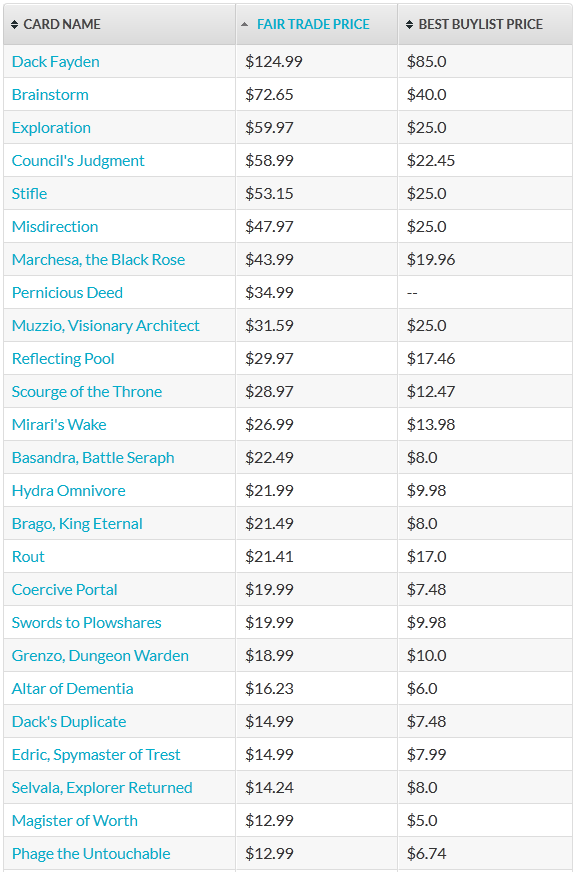
image00

Dack Fayden – Surprisingly the first foil on the list is one that you should watch out for. Not in a good way – in a “If this guy doesn’t put up any results over the next few months, abandon ship!” kind of way. Does anyone know if Dack Fayden is even any good at this point? I haven’t seen any decklists that utilize him yet in Legacy or Vintage. It could be too early to tell but I’m not going to hold my breath. His abilities are cool though they don’t really provide an end game like Jace, the Mind Sculptor or Liliana of the Veil.

Brainstorm – Here’s a foil we can all get behind! There are several foil printings of Brainstorm already available to the MTG populace but giving us another definitely won’t hurt, especially with that awesome new art. Don’t get me wrong, I love the first foil version’s Masques art yet the new Izzet themed Brainstorm is great as well! This is the first time that this art has had a foiling so I expect this foil version of Brainstorm to maintain its value and then continue to gain value as the years go on. Actively trade for these copies when you can.

Exploration – A first time foil and found as a playset in a well known Legacy archetype? Sounds like a recipe for a winning pick up. Years down the road, players will wish that they were able to pick up these foils for $60 – however, in the short term I could see this price dropping a bit. Once the players that want these foils pick them up, since the Lands Legacy archetype isn’t a popular choice (you can thank Tabernacle’s insane price for that) and casuals have their fix for EDH the price could easily dip down for a bit while demand is low. Once the dip happens, that will be the time to move on these foils. As these foils continue to sit in people’s EDH and Legacy decks without moving back into the market, the price will re-adjust itself accordingly and I can definitely see these hitting $100 and continue to trend upwards once they become really hard to find.

Council’s Judgment – Ahem, I’ll have to reserve judgement about this particular sorcery’s foil price until I start seeing some TNN’s being exiled with regularity in Legacy. LSV puns aside, $60 for foils of this while normal copies can be had for as low as $8 on TCGPlayer seems greedy. This ain’t Abrupt Decay. It can be countered, costs three mana, requires a heavy commitment to white to cast, and is a sorcery – four serious strikes against it in a format defined by counterspells. Golgari Charm feels better than this most of the time. Maybe I’m severely underestimating this card but you won’t see me buying this for $60 foil.

Stifle – $50 for a foil that has been printed in foil twice already? And we’ve already had a foil printing of this art before in the form of a judge promo? No thanks, I think I’ll pass on this one. There isn’t a reason that this particular foil version will continue to go up and it has every reason to decline in value once more Conspiracy is opened – just like Commander 2013 there will be no end to this product for quite a while, so I expect this foil to be one of the foils that drops in price over time.

Misdirection – Similar to Brainstorm, we haven’t had a Misdirection foil since Masque’s block and we’ve got new art to boot as well. The new art is pretty badass, and even though the old art is iconic I can definitely see players wanting to get their hands on some Conspiracy foils of this card. $48 is a bargain compared to the $140 it will cost you for a Masques foil. In the long term, this price will probably only continue to go up as it seems that Misdirection will have a place in Legacy as long as Sneak and Show exists in the format. Barring any bannings, such as Show and Tell and/or possibly Sneak Attack being banned, expect this foil version of Misdirection to go up over time. Speaking of which, judge foil Show and Tells feel very underpriced to me – they are almost the same price as the regular copies!
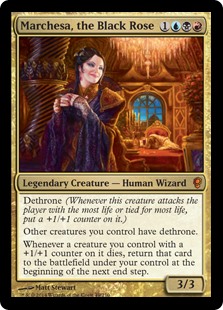
Marchesa, the Black Rose – “I’m not even sure if this card is even good in commander.” I thought to myself at first. The thing with Marchesa is that you need to look past the Dethrone stuff, which honestly isn’t going to be that relevant all the time (when is Grixis ever an aggro deck?) and instead focus on that last line of text. “Whenever a creature you control with a +1/+1 counter on it dies, return that card to the battlefield at the beginning of the next end step.” That’s sweet, pretty much constant recursion of your creatures if you build a deck around +1/+1 counters with her! Is it $44 sweet for the foil version though? Honestly, I think the answer is probably. She is in popular commander colors in addition to being a great attrition commander. I’m not sure if that $40 mark will budge for a quite a while (and if it does it won’t go down that much) and I believe in the long term you only stand to gain with a foil of her. She’s also mythic which helps to maintain the high foil price.

Pernicious Deed – For a $35 foil, you aren’t getting a bargain but you could do worse. Deed already has two foil printings and this one keeps the old art with a new border? Not sure if I like that combination. At least with the judge promo they recreated the art to better match the updated card border for multicolored cards. I don’t think the new card border looks good with the old art, though that could just be my nostalgia kicking in since I started playing when Invasion was legal in Standard and Deed is a fond memory from that era. Regardless, I don’t think I want to be picking up foil deeds of this variety right now. I can’t see the foil price increasing long term and it can only go down in the short term.

Muzzio, Visionary Architect – I foresee this guy replacing a lot of Arcum Dagsson’s  as commander so that players will be less inclined to think that you are going to combo off on them at any given moment if you’re currently running an Arcum commander deck. Muzzio was a great way for R&D to design a new Arcum without making it busted – he is powerful in his own right but there is a still a randomness to your artifact selection which nerfs most combo shenanigans. Speaking of Arcum Dagsson, foil versions of him can be had for $25 – cheaper than Muzzio is currently. I recommend you stay away from foils of this card for a while until he at least matches Arcum in price or even falls a little bit lower than him.

Reflecting Pool – I’m not sure if I am a fan of this foil at $30. It’s not really played in Modern or any other eternal formats, so its demand comes strictly from commander. There are already Shadowmoor foils out there for Reflecting Pool at $70, so like Deed you can get the bargain foil from Conspiracy if you wish. Unfortunately I wouldn’t really expect this to rise in price for quite a long time, if ever.

Scourge of the Throne – I’m not really a fan of this card. No haste, Dethrone (not a thrilling ability outside of casual and Commander), and requiring you to attack the highest life total to take another combat phase during your turn seems underwhelming to me. However people will collect this card simply because it is a dragon, so maybe my impressions of the card have nothing to do with how awesome it might be to the casual crowd – maybe $30 for a foil of this will be a bargain several years down the line. I’m not going to actively pick up foils of this but if someone offers me the right price I’m not going to turn it down.

Mirari’s Wake – See my review for Deed and Reflecting Pool. Another card with some foil printings that won’t be moving in price any time soon. I would not pick up this foil expecting it to go up significantly over time.

Basandra, Battle Seraph – Similar to Scourge of the Throne, I expect this to maintain value purely due to being an angel. Casuals love their angels and people collect them, especially foil versions. Basandra isn’t that powerful yet this is the only foil version of her, so the price will reflect that accordingly.

Hydra Omnivore – This guy is insane in commander and will be a great target for foil. The non-foil version from Conspiracy is $5 which is significantly lower than the commander counterpart. I think its odd that they reprinted it at mythic even though it was only a rare in the Commander set. Regardless, since this is the first foil version of the card it will command a premium like Basandra. Unlike Basandra, this foil has a chance of taking off as the years go on because it packs quite a punch.

Brago, King Eternal – In my opinion he is only a marginal commander. Even if he is in your commander deck, his stats are pretty underwhelming for something that needs to attack and deal combat damage in order for his effect to go off. His nonfoil version is only about $1.50 on TCGPlayer. I would stay away from this foil for a while and wait for it to dip down a bit.

Rout – Since this has brand new art, and the art happens to center around Elesh Norn, I predict that many people will want the foil version of this art simply because they are fans of Elesh Norn. It is sitting around $20 right now, which I think is a fair price for a card that is really good in commander. It has the chance to dip down in price once the casual crowd has fulfilled their demand for the time being (the first year the product is out) but over time the foil version featuring this art could become quite collectable.

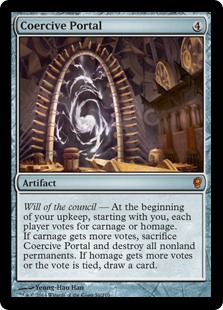
Coercive Portal – Even though it says that this foil is $20 on the sheet, I’ve checked on TCGPlayer and the foils are basically all sold out already. There were two listings left on Friday and they were at $50 and $220 respectively… hmm, what is going on here? Did someone find some tech for Legacy MUD decks that they want to utilize? Is this a better version of Nev’s Disk and/or Staff of Nin? I guess if you were able to buy the foil for $20, congrats you’ve made a killing on the price jump. I don’t think it’s staying there though. With regular copies being listed for around $2 on TCGPlayer I don’t see how this foil can be over $50 already so quickly. Wait for the hype spike to die down before trying to get foil copies of this.

Swords to Plowshares – Even though Swords has several foil printings already (judge promo, FTV 20, and FNM) the Conspiracy foil will be the first with the latest art that isn’t in the FTV foiling style. This will appeal to many players as the new art is quite awesome even if it isn’t Jeff Menges – Terese Nielsen is just as good, if not better right? $20 is a good starting point but I would expect this to climb higher as the years go on. Swords is always a solid card, just like Brainstorm, so foil copies whatever they look like will always be sought after.

Grenzo, Dungeon Warden – Grenzo is probably the most unique B/R card designed since Cauldron Dance. First of all, he is a B/R creature with an X in it’s mana cost – the first time something like this has been designed. Second, his activated ability is weird yet powerful. It makes your opponents think twice before casting Hallowed Burial or Terminus – or even Spell Crumple! Grenzo will break your guys free from the bottom of your library and put them right back into play. Price wise, at $19 for foil it seems a bit expensive at the moment. Wait a while for Conspiracy to continue to be released. Once his foil drops a bit then it will be the time to pick him up since his effect is so unique.
Altar of Dementia – A first time foil and a great casual card, Altar of Dementia foils will be sought after by those trying to foil out commander decks. I feel that $16 is a pretty fair price and that it will only go up over time. Once the foils start increasing, I could definitely see this going up to $40 and even surpassing it one day.

Dack’s Duplicate – A very unique twist on Clone. I love this card! Copying a creature with haste and Dethrone is no joke, all for that R in it’s mana cost. This is a great Clone variant and will be sought after for years to come. $15 seems like a great deal for foils of this, so I would look to pick up a few copies for your EDH decks and not let them go.

Edric, Spymaster of Trest – Edric is an awesome commander, but being banned from Duel Commander really stifles the price. $15 is pretty good for foil versions since Commander Arsenal versions are around $20. I can foresee this version hitting $20 over time and probably even going past it once the CA version starts to pick up steam. If you don’t have a foil Edric by now, I would pick him up as I don’t think over time he is going to get any cheaper.

Selvala, Explorer Returned – I’m not a huge fan of this card as I don’t feel it does anything spectacular. It’s no Rofellos and requires white mana to generate a bunch of green mana which is awkward. I like the life gain, however letting everyone draw a card seems kind of bad in G/W. $15 feels like too much, wait a bit for it to drop in price and then go in on the foil if you want her.

Magister of Worth – A great casual card, but the promo is really going to hurt the regular foil price for quite some time. Don’t get in on this foil for a while if you want a Conspiracy foil version. Instead trade it into another foil like Muzzio or Grenzo which are sure to go up over time.

Phage, the Untouchable – She is a reprint foil like several others on the list, so I would recommend picking this foil up only if you are looking for a bargain and not looking to make a profit on her some day. She’s only a collector’s item at this point as she can’t be a general and is really hard to get into play in a casual game. I’d rather have the original Legion’s foil as it is only $4 more.

Foils Abound

I think that looking at foils from Conspiracy will be much better in the long run than looking at non-foils simply because the price of all the non-foils will be severely depressed by the wide distribution of this product. My predictions could be severely off if this product is nowhere near as popular as everyone predicts, in which case if you decided to pick up regular copies of cards you would have made more money in the long run than picking up foils. However, I do think the product will be very popular and will be drafted for quite a while by casual players that make up the majority of the MTG population.

There are both competitive and casual foil targets that can be acquired that I think will only keep going up in the future. Conspiracy is an awesome set, and if Wizards decides to do something like this again then this first generation Conspiracy could even hold value based on being an original – just like the first Commander product and Duel Deck product command a premium. Only time will tell!


King of the Buylists

By: Jared Yost

It was a great disservice to many when I excluded Card Kingdom from my buylist data crunch article, so I decided to gather the buylist data from their website for uncommons, rares, and mythics legal in Modern in order to compare them to the other Modern buylists that MTGPrice tracks.

I will also list out the TCGPlayer updated information I was able to calculate based on the 8.5% TCGplayer fee + a PayPal / credit card processing fee of approximately 3%. Hopefully this will paint a more realistic picture of the costs associated with buylisting and selling on TCGPlayer.

I also want to mention shipping costs, which can be significant over time depending on the volume of cards you are buylisting or selling. It usually costs about $2 to ship a padded envelope First Class USPS. This is what I find myself shipping the majority of the time if I am buylisting something. If you include insurance your mileage will vary, but if you are sending hundreds of dollars of cards to a buylist you may want to consider adding insurance to the shipping cost. If we add insurance it would come to approximately $1.65 for every $100 worth of cards that we ship. If we assume that the average buylist shipment is about $200 per shipment, that’s another $3.30 we need to account for insurance if we are including that. That comes to about $5.30 to ship a package, whether that is to an eBay / TCGPlayer user or to a buylist.

It is hard to account for shipping concretely in my calculations – how often are you actually spending $5.30 to ship something? If I used that number and tried to calculate a percent earned after paying for shipping it wouldn’t look realistic at all. There are ways to reduce your shipping costs by introducing risk but that’s not something I’m looking to get into right now. Just as an example, maybe all you need is $0.49 to ship a plain white envelope (PWE) with the cards in it. I’ve done this plenty of times on eBay and have never had an issue. For buylists this is the same, if you are only sending a handful of cards. It all comes down to trust in the system yet I think you should err on the safe side and think about getting insurance if that handful of cards starts climbing past three digits.

Before I list the updated data, some notes about the Card Kingdom data set:

  • I’ve only included Card Kingdom and the market competitors in this data set. If you want to see my first data set for the other vendors TCGPlayer tracks, please see my first article on this topic.
  • I’ve updated the TCGPlayer % Loss to account for their fees and Payal’s fees for selling through TCGPlayer.
  • I’ve decided to leave out commons for this one – the numbers last time were so abysmally low that I didn’t think it was worth it for me to gather the data from Card Kingdom for them. If you think otherwise, leave me a comment and I can update the article to include common information.

Now, the updates:

MYTHIC
Vendor Average Total Buying Sum Total Prices Median Mode % Buying Avg * Buy% % Loss Total Real eBay/TCG Total Real eBay/TCG Loss % Loss Total Update
Fair $9.41 324 $3,048.12 $5.56 $1.30 n/a n/a 0.00% n/a n/a 0.00%
eBay $7.86 324 $2,546.42 $4.50 $0.99 100.00% 7.86 -16.46% $2,189.92 -28.16% -28.16%
TCGPlayer $7.10 323 $2,292.86 $3.51 $0.60 99.69% 7.08 -24.78% $2,029.18 -33.43% -33.43%
Card Kingdom $5.62 307 $1,726.92 $2.50 $3.00* 94.75% 5.33 -43.34% n/a n/a -43.34%

*Only 10 mythics on Card Kingdom’s buylist were at $3 – like ABU and other large vendors, they have a very diverse buylist for mythics since they are buying 307 mythics.

RARE
Vendor Average Total Buying Sum Total Prices Median Mode % Buying Avg * Buy% % Loss Total Real eBay/TCG Total Real eBay/TCG Loss % Loss Total Update
Fair $2.83 2752 $7,800.37 $0.71 $0.38 n/a n/a 0.00% n/a n/a 0.00%
eBay $2.62 2746 $7,206.26 $1.00 $0.99 99.78% 2.61 -7.62% $6,197.38 -20.55% -20.55%
TCGPlayer $2.02 2741 $5,548.69 $0.42 $0.25 99.60% 2.01 -28.87% $4,910.59 -37.05% -37.05%
Card Kingdom $1.62 2063 $3,348.43 $0.26 $0.05 74.96% 1.21 -57.07% n/a n/a -57.07%


UNCOMMON
Vendor Average Total Buying Sum Total Prices Median Mode % Buying Avg * Buy% % Loss Total Real eBay/TCG Total Real eBay/TCG Loss % Loss Total Update
Fair $0.44 3016 $1,325.46 $0.21 $0.17 n/a n/a 0.00% n/a n/a 0.00%
eBay $1.14 3002 $3,428.58 $0.99 $0.99 99.54% 1.13 158.67% $2,948.58 122.46% 122.46%
TCGPlayer $0.24 2985 $724.00 $0.10 $0.10 98.97% 0.24 -45.38% $640.74 -51.66% -51.66%
Card Kingdom $0.34 641 $217.98 $0.09 $0.05 21.25% 0.07 -83.55% n/a n/a -83.55%


NON-COMMON
Vendor Average Total Buying Sum Total Prices Median Mode % Buying Avg * Buy% % Loss Total Real eBay/TCG Total Real eBay/TCG Loss % Loss Total Update
Fair $2.00 6092 $12,173.95 $0.39 $0.17 n/a n/a 0.00% n/a n/a 0.00%
eBay $2.17 6072 $13,181.26 $1.00 $0.99 99.67% 2.16 8.27% $11,335.88 -6.88% -6.88%
TCGPlayer $1.42 6049 $8,565.88 $0.23 $0.10 99.29% 1.41 -29.64% $7,580.80 -37.73% -37.73%
Card Kingdom $1.75 3011 $5,293.33 $0.24 $0.05 49.43% 0.86 -56.52% n/a n/a -56.52%

Card Kingdom Compared to the MTGPrice Vendors

image00

Adding Card Kingdom to the average buylist graph shows us that it is indeed a competitive market player. They offer a higher mythic buy price on average than ABU, which was previously the vendor that offered the highest average. They also are very competitive on pretty much all non-common cards as well by offering 0.86 on average based on the amount of cards they buy versus ABU’s 0.85 average. A slight edge, but still significant in the big picture since it means that they buy just about the same amount of cards as ABU but generally offer higher prices on those cards.

image01

Here again we can see that Card Kingdom has a ton of cards on their buylist compared to the other vendors. Like ABU, they have an exceptional amount of mythic rares on their buylist and have a demanding want list. Card Kingdom slightly eeks out the edge with 307 mythics versus ABU’s 293 mythics. They also buy about the same number of rares as ABU, only behind them by 24 rares.

One thing Card Kingdom lacks is Uncommons – even going through the buylist manually collecting the data I could see this. For many Modern sets, Card Kingdom only looks for about 5 to 6 commons from each set. They clearly must have a lot of uncommons in stock that they want to sell or another reason they aren’t actively buying uncommons from players. Looking at the graph you can see this, but citing the numbers they only want 641 uncommons versus ABU’s 794 and CFB’s 888. For uncommons, it is more hit or miss for Card Kingdom than other big store buylists.

I’m going to skip showing the Median and Mode buylist by vendor as I’ve realized that they can be misleading, especially considering the variety of prices that the big box vendors offer. So I will skip right to the percent loss.

image02

Here we’ll want to look at TCGPlayer and Card Kingdom since I’ve updated the TCGPlayer loss to account for the fees just like eBay. Compared to the old data, accounting for fees you are losing -37.73% rather than the -29.64% than I had originally indicated – this is a pretty huge oversight on my part! That’s another 8% loss that I didn’t originally account for and really makes a difference when you also consider shipping and possibly insurance. It helps bolster the argument that when you buylist something, you don’t have to wait to sell them to get your cash – time is money after all and we’ve just found out that TCGPlayer isn’t quite as profitable as previously indicated.

eBay hasn’t changed unfortunately, which is because of the absurdly high averages for uncommons I was getting since MTGPrice was probably also including sold playsets in their calculations for a fair eBay price. That and I failed to account for other factors like listing fees, (which only really happen for big time sellers who have more than 50 listings per month) shipping, and shipping insurance if the order required it. I’ll talk about shipping more in the next section since I didn’t really know how to integrate this into my current data set.

Shipping

Now I’d like to talk about how shipping factors into all this. There are several options you can pursue for shipping, some of which I mentioned above:

  • $2 for a 3oz padded envelope package through USPS First Class mail. This is to anywhere in the US if you are mailing within the US.
  • For those who are international, I’ve heard that $6 is the average cost to ship something to the US – this is eating further into any profits you might make if you decide to buylist cards to American shops.
  • Shipping insurance. For USPS First Class mail that’s about $1.65 per $100 worth of value. Internationally USPS offers insurance up to $2500, which could be up to $24 to insure – I’m not sure if other countries offer similar rates but I would assume that the USPS would base this on a global metric.
  • PWE for $0.50

Which option is best for a buylist? I’ve had success with mailing 3oz padded envelopes to vendors like ABU and Card Kingdom on several occasions without an issue. I’ve fit entire tournament packs stuffed with cards into these envelopes and the USPS has shipped them, no issue. When I had packages valuing $200 or more, I bought the insurance which was about $4 more for shipping and gave me peace of mind. I would recommend this approach for buylists because generally you will want to send them a ton of cards at the same time in order to collect a  big payoff quickly from any financial opportunities you’ve had. Using a padded envelope in addition to insurance will allow you to send off these larger packages without leaving too much on the table – trust me, losing $200 in the system once is enough to make you want to get insurance forever. Please don’t be that guy!

I’ve also shipped $0.50 envelopes when someone won an eBay auction where I was selling something. I think I even sent a playset of Jace, Architect of Thought this way without an issue. Obviously this was a huge risk I was taking on my part but I wanted to discover for myself just how big of an issue it was to ship with PWE’s – never had a problem so far but I always seem to hear horror stories from people. In my experience if you are only selling a playset of a card then I would ship in a PWE and not worry much about it but make sure you get insurance if you are selling something like a foil Snapcaster Mage or a playset of Thassa’s. At least you could do that to save a few bucks on a padded envelope and extra shipping for that envelope through the USPS.

The guideline I follow is ship lower cost items cheaply so that you save on shipping costs. PWE’s for any uncommons or other random rares you may sell in playsets is fine and it will hardly eat into your profits like the eBay or TCGPlayer fees would. Buy better packaging for larger orders or pricy cards (think dual lands or other Legacy staples) and include insurance if it starts getting up past $200 or more. I’ve done this so far without a hitch and I can say I’m quite happy with the approach.

Last Word

Hopefully my inclusion of Card Kingdom has shown that they are also competitive in the buylist world and go toe to toe with ABU on mythics and the amount of cards that they buy. Once MTGPrice adds more card sources to their data set, including potentially European or other international sources, it will only further help us all understand where to better focus our efforts when buylisting.

Maybe I’m missing something simple but shipping seems hard to include in the dataset without greatly skewing the numbers the more I think about it. It could be included but I would need more time to think about specific rules and scenarios of when to use and not use shipping insurance and how to calculate the risk of a PWE versus a padded envelope with the insurance. Jason might be able to chime in here since I’m sure he has way more experience in this realm than me. At the very least, you’ve all read about my experience with shipping and can take it as you will. I wanted to talk about it though because it is a real cost that sometimes gets forgotten in the excitement of buylisting something for higher than you bought or traded.